What does a product configurator do?
Written by The Kickflip Team
November 15th, 2025
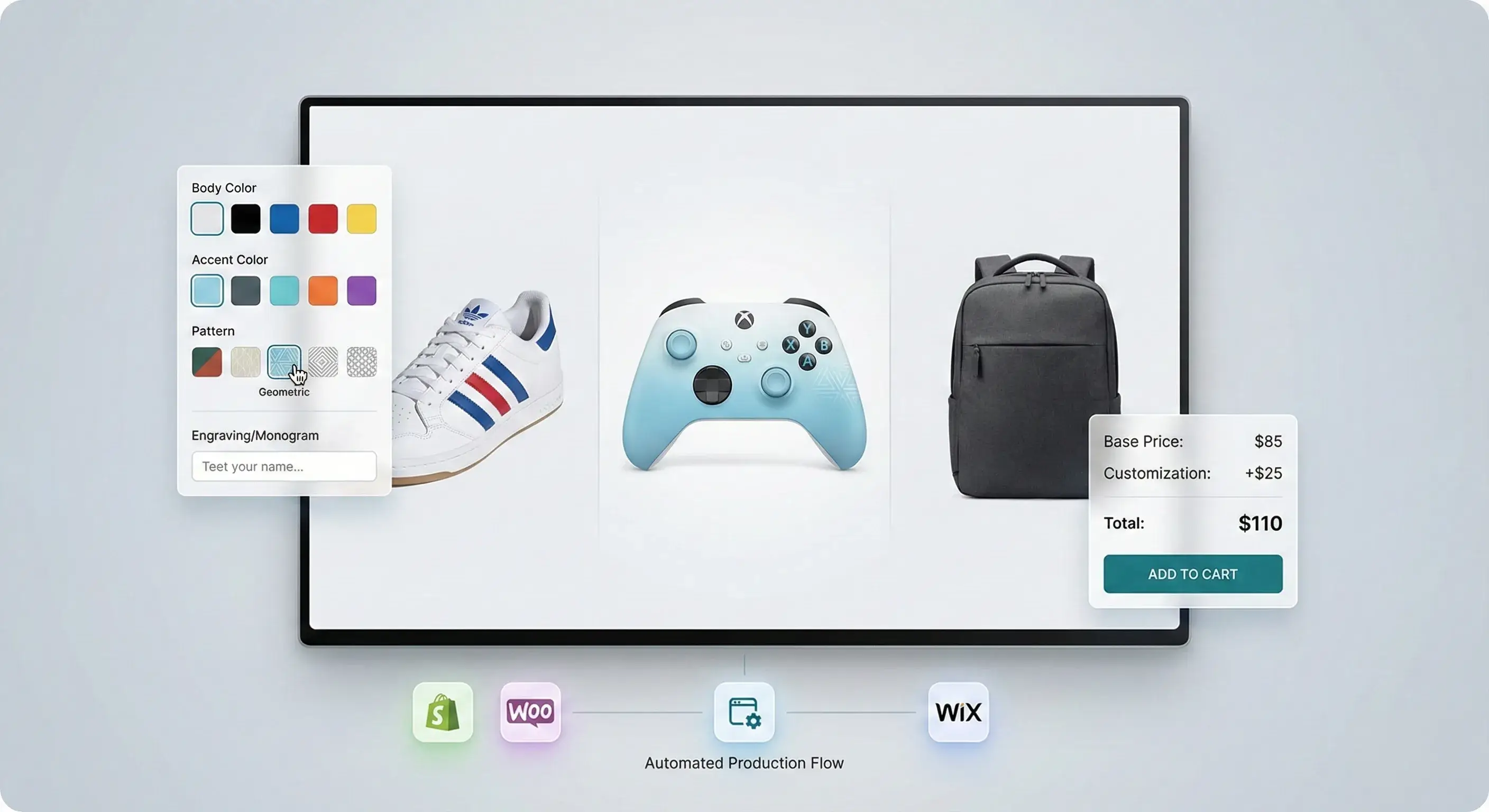
Table Of Contents
Most eCommerce brands want the same thing: to let customers design products their way without getting trapped in an operational nightmare to do it.
Previously, customers had to mock up their designs or provide a "concept," which could've been a half-baked idea. The burden was on the eCommerce provider to understand their idea and provide multiple concepts. This process took days, if not weeks, to get the ball rolling.
Even if 10% of your customers want a customized product, your operations break down. And you find it really hard to scale.
This is the exact problem product configurators were built to solve.
In this article, we’ll explain what a product configurator does and how eCommerce brands can benefit from them.
What is a product configurator?
A product configurator is software that lets customers design customizable products through an interactive interface.
Here’s an example of a no-code product configurator from Hemmet, an accessories brand:
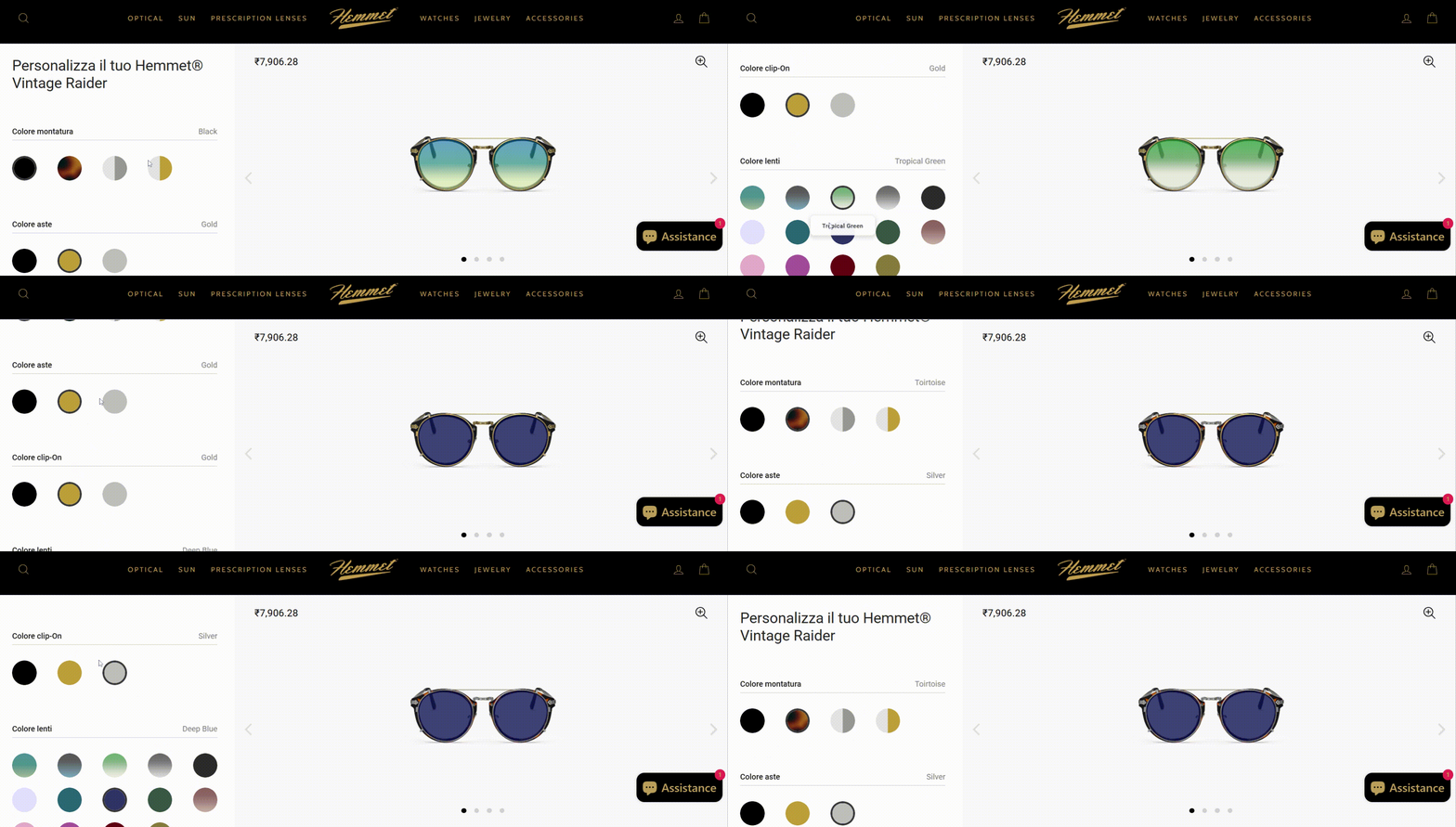
The software connects your customer's choices to your product catalog. For example, if a customer wants blue lens sunglasses instead of a black one, they can choose the option in the configurator. As long as you have the option baked in on the backend, you can offer as many variants as you want to.
When it comes to choosing the best configurator, it comes down to five things:
Can it handle complex products with hundreds of options?
Does it enforce rules so customers can't pick impossible combinations?
Can it generate production-ready files your team actually uses?
Can you add all your products without custom coding on the backend?
Does the customizer offer a premium on-brand look?
For brands selling custom products, the configurator becomes your storefront. It doesn't just let the customer personalize the product, but it also increases their confidence that you'll deliver exactly what they asked for.
What does a product configurator help eCommerce brands do?
There are several benefits of using product configurators. Let’s look at how they help you specifically:
1. Helps you provide real-time visualizations for every product line
When customers design custom products, they need to see what they're creating. A configurator shows them precisely that.
For instance, they can pick navy blue for sneaker uppers, and the image updates instantly. Or if they want gold laces, they can do that too.
Instead of just choosing an option on the site and hoping it looks great, they can see everything in real time.
This visual feedback transforms how people shop. They're not guessing what their custom jacket with contrast stitching looks like or imagining what a gaming controller with specific button colors looks like. They see it, adjust it, perfect it.
As a result, those who use the capability are far more likely to buy it because they've already imagined themselves using it.
2. Lets you support unlimited variant combinations
A Deloitte report found that 75% of customers are more likely to purchase from brands that offer personalized experiences. But it doesn’t stop there. They would also spend 37% more money on these brands.
However, traditional ecommerce platforms force you to create separate SKUs for every product variation. If you need five colors across three sizes, you'll need to add 15 SKUs. When you add more variations, inventory management becomes a nightmare.
It’s one of the reasons most platforms start charging per variant or break down entirely when you hit certain limits.
But with product configurators, that’s not the case.
You define the customization options once, and the platform generates combinations on the fly. This way, you don't have to create individual product listings before you receive any orders.
🔥 Pro tip: Use a platform that lets you combine questions to generate separate SKUs automatically. This way, you can easily manage inventory and ensure customers choose options that are actually available.
3. Enables dynamic pricing that updates as customers build their product
Every customization choice affects the final cost of goods. For instance, premium leather costs more than standard fabric, while larger sizes require more material.
You don't need to have dedicated people to calculate this cost. The issue is that this introduces errors in the process and eats into your production time.
Configurators handle pricing automatically.
You set pricing rules based on factors like:
Materials
Sizes
Components
Labor
Color
Texture
When customers make selections, prices update in real time. They see exactly what they'll pay before checkout. So you built trust with your customers and, as a result, reduced abandoned carts.
4. Allows you to enforce logic rules and option dependencies automatically
Sometimes, customization combinations don't work. Some components are incompatible with others, or hardware choices depend on size selections. If you don't have logic rules in place, your customers can create products you can't actually make.
Configuration rules solve this by enforcing dependencies between options. If someone picks a small size, the configurator automatically hides components that only work on larger versions.
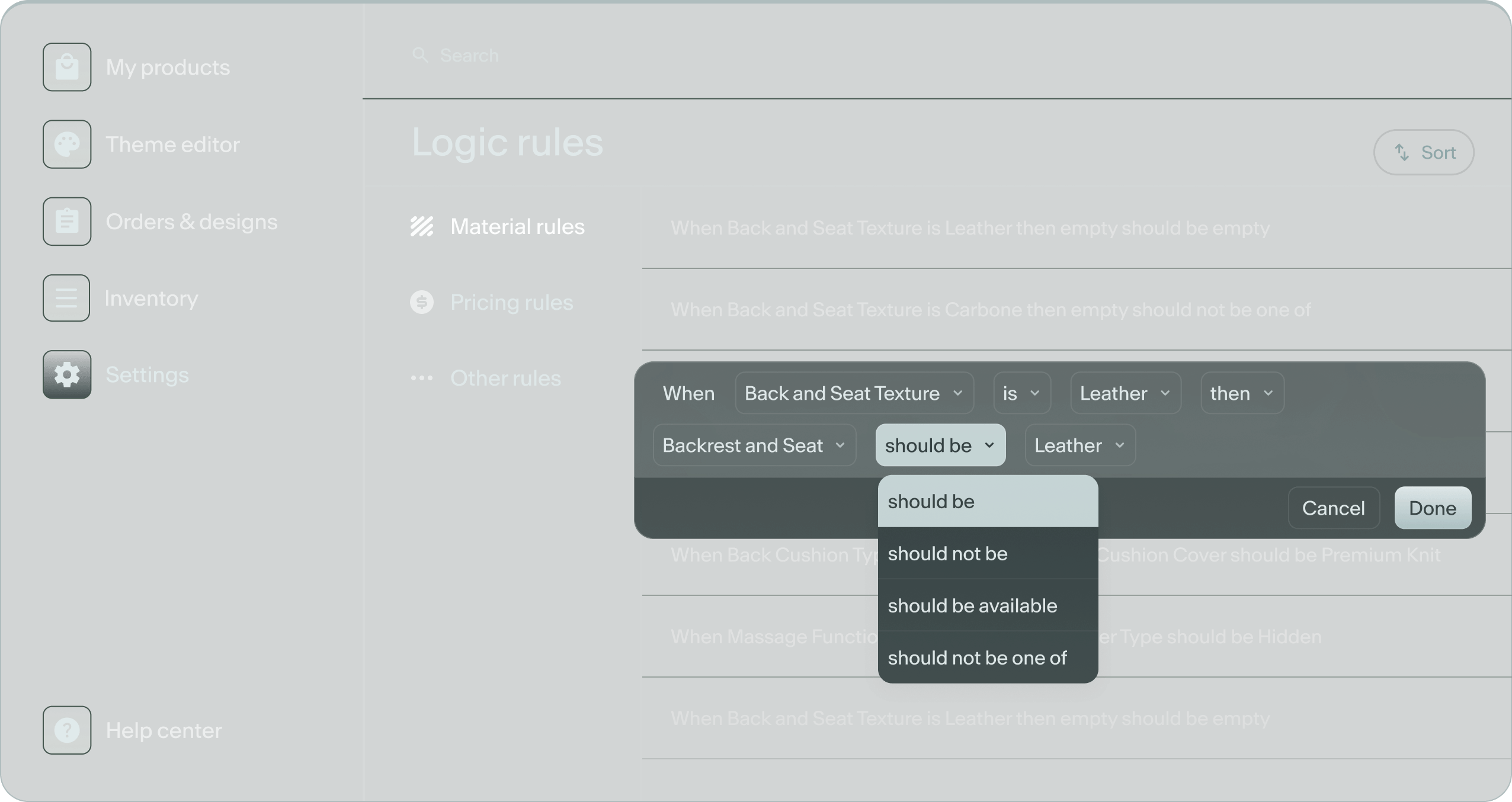
Example of a natural language logic rule in Kickflip
The platform guides customers toward valid combinations, which means:
Fewer production errors
No back-and-forth emails clarifying orders
Cleaner specs sent to fulfillment
Happier customers get exactly what they designed
Your manufacturing process stays smooth because invalid orders never make it through.
5. Improves the shopper experience with a premium, branded customizer build
Your configurator lives on your storefront. It should look like your brand, not a generic widget bolted onto your site.
The best product configuration software lets you control colors, fonts, layouts, and user flow so the customization experience feels native to your store. And this matters more than you might think.
Design appeal is usually half the battle, as many consumers associate it with product quality. An on-brand configurator signals that you care about details and take customization seriously.
Here’s an example of what that looks like for different brands:
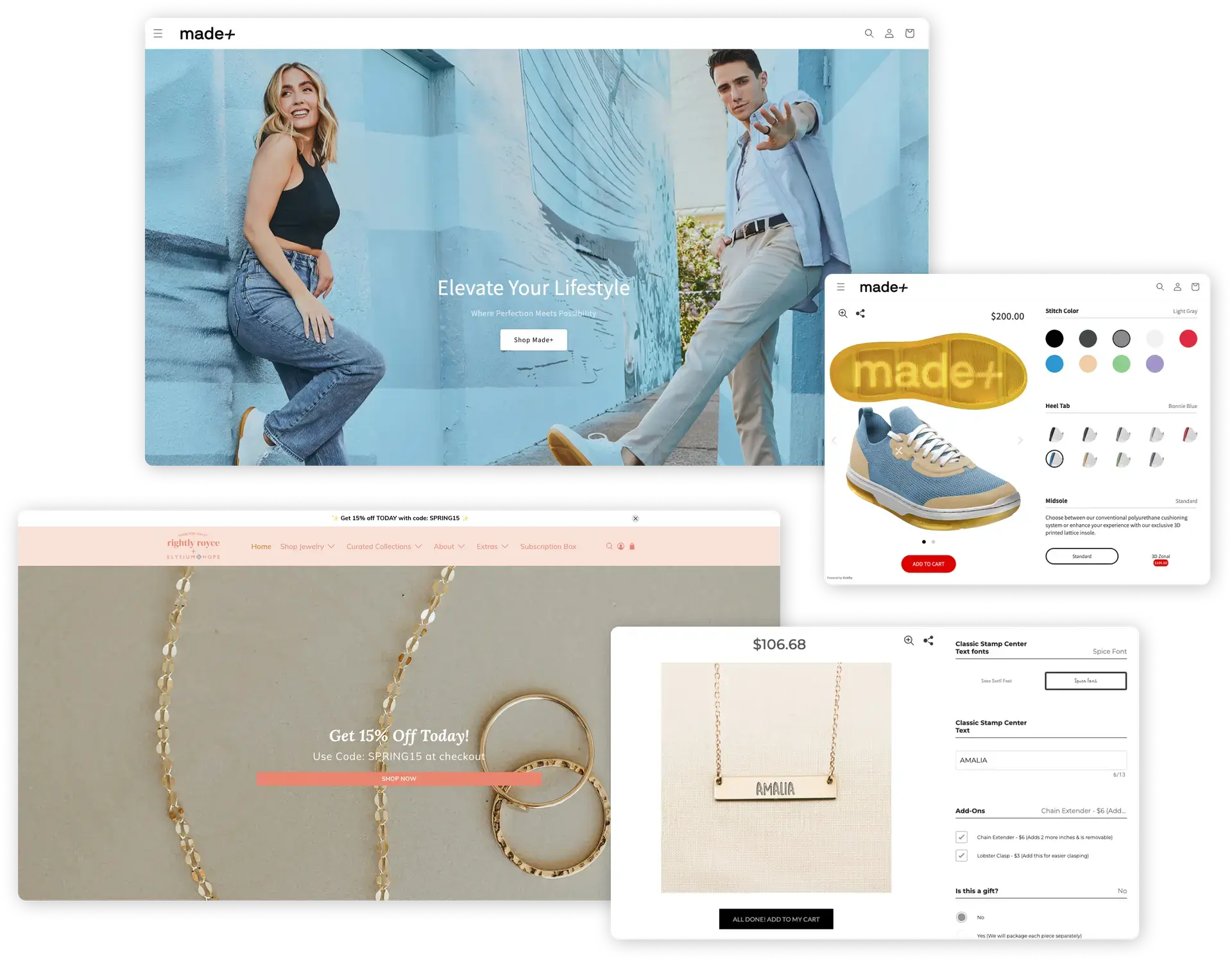
Customize the product configurator based on your branding
You're competing against brands that understand this, so your configurator becomes part of your competitive positioning.
6. Turns customization into a revenue lever by increasing AOV
"When the customer finally picks something that they like, they've gone through a kind of a headache of a journey. Adding a couple of curated options for them is refreshing," says Cael Schwartz, head of growth at clothing brand Mugsy.
When customers go through all that extra effort, it only makes sense that they’d be more interested in buying from you. Customization does two things:
It increases the product's cost due to additional layers.
It encourages customers to shop more on your site.
It also helps you learn more about their preferences for future sales.
All of these factors help you increase the average order value (AOV) over time. Plus, your customers also get more value from you. It’s a win-win for both ends.
7. Streamlines back-office workflows for order fulfillment
Every custom order you take manually requires coordination. Here’s how it usually goes:
A CS team member reads the customization request
They clarify the details via email or call
Then your designer offers multiple concepts
The CS rep manually calculates pricing and generates specs
Once finalized, the concept is sent to production
But many mistakes can happen in this long and arduous process. A configurator automates this entire workflow.
When customers finalize the customized product and add it to their cart, all the information is automatically sent to your team. So you can focus on fulfillment rather than manual configuration.
Here’s an example of how that works in Kickflip:
8. Reduces returns and error rates by giving customers what they want
The biggest issue with customization is that if a customer returns a product, you can't resell it. While many eCommerce brands don't offer returns for this reason, another way to avoid disappointing customers is to let them see what they're getting.
As of 2025, 62% of retailers say their return rates are either staying the same or decreasing. Most returns happen because customers didn’t receive what they thought they would. And that’s partly because they can’t visualize the final customized product.
A product configurator sets clear expectations upfront. Customers can see what they design and how it’ll look, reducing the likelihood of returns and protecting your margins.
9. Gets you live fast without months of custom dev work
Our estimates say that custom product configurators can take months to build. And the costs start at $350,000. You'll need to account for the following:
Developers
Designers
Software
Regular updates
Ongoing maintenance
Most brands don't have that kind of time or resources.
Modern product configurators are usually no-code. So, you can launch products in days, not months. You upload product images, define your options and pricing, set your rules, and go live. The infrastructure already exists. It's about getting up to speed and launching quickly.
10. Integrates with your ecommerce platform and tech stack
Your configurator needs to work with your existing ecommerce platform and backend systems. Many eCommerce brands use platforms like Shopify, WooCommerce, Wix or similar platforms.
In those cases, you'll need your inventory to sync and connect your customer data directly.
A modern product configurator like Kickflip comes with these capabilities built in. As a result, your team manages custom orders the same way they handle standard ones, just with better data and fewer headaches.
“By far, and I mean it, the best customizer available on Shopify. Don't look for other apps, they don't even come close to it. Easy to understand and handle, it gives options for all types of products and works very well (as well as being beautiful with a quality aspect). HIGHLY RECOMMENDED.”
— Saber Naceur, Head of Strategy & Creator, Vinylacy
11. Supports bulk orders, B2B workflows, and volume pricing easily
When you’re catering to other businesses, it’s typical for custom orders to come in huge volumes. For instance, corporate clients might want branded merchandise with individual names or colors. But it’s hard to manage this manually.
Product configurators built for B2B settings handle:
Volume orders with tiered pricing
Minimum order quantities
Saved designs for reordering
Individual customization within team orders
You can serve both individual consumers and business clients through the same platform. Your customers (or corporate clients) can configure multiple items, apply tiered pricing, and place large orders without the hassle.
12. Scales with your brand as you expand product lines, markets, and categories
You might start with one customizable product. If it works, you'll want more. Your configurator should grow with you, handling additional product lines without requiring you to rebuild everything or switch platforms.
It means your customization infrastructure becomes a long-term asset rather than something you'll need to replace when you reach certain thresholds. When you eventually want to expand, you won't have to spend weeks just designing new concepts or offering only a "Reach out to support" option.
You can create reusable components like images, logic rules, texts, and fonts, and build product lines in days.
What are the use cases of a product configurator?
Here are a few ways in which eCommerce brands can use product configurators in different niches:
Apparel and footwear
When you offer custom clothing and shoes options, it lets customers choose:
Colors
Materials
Sizes
Personalization options like names or numbers
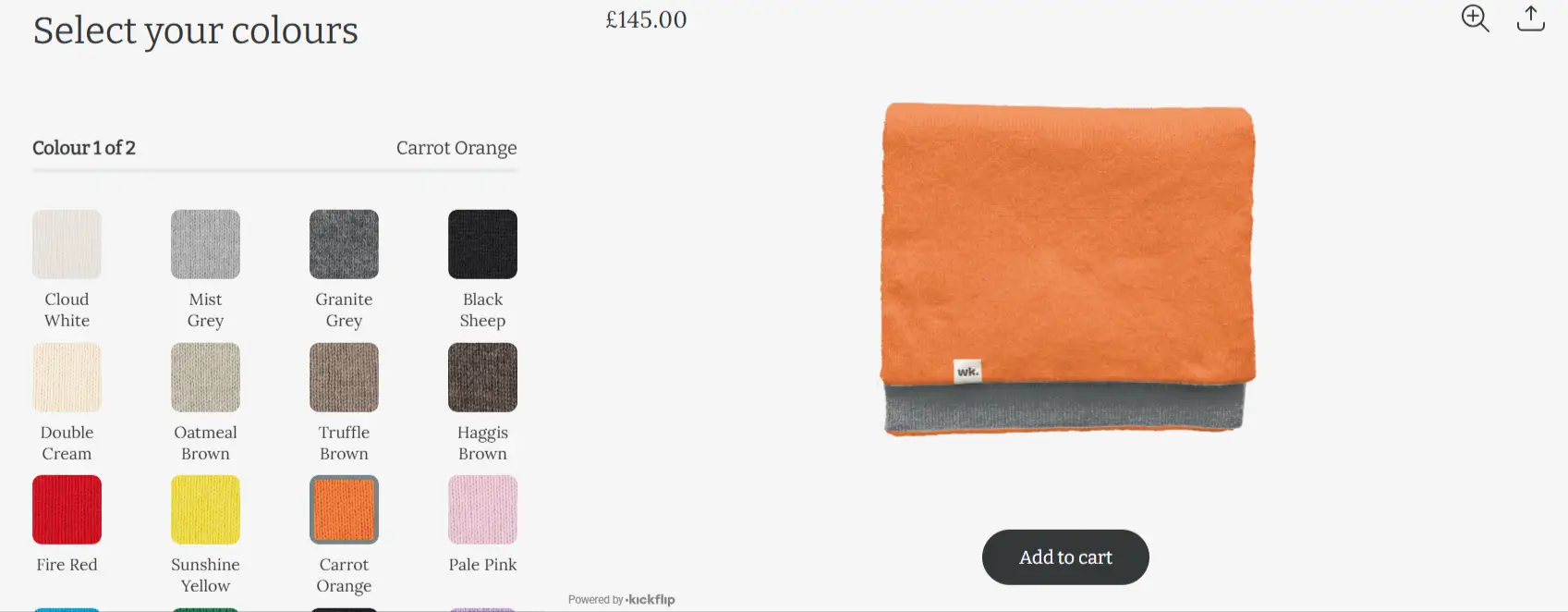
Brands can offer team uniforms, personalized sneakers, or made-to-order jackets without managing inventory for every possible combination. The configurator shows how designs look on actual products while enforcing rules around size availability and material compatibility.
Here’s an example from Woolkind, a woolen knitwear brand:
Electronics and gaming
Gaming controllers, phone cases, and electronics accessories thrive on customization. Customers tend to want choices like:
Specific colors
Custom engravings
Component choices
Material
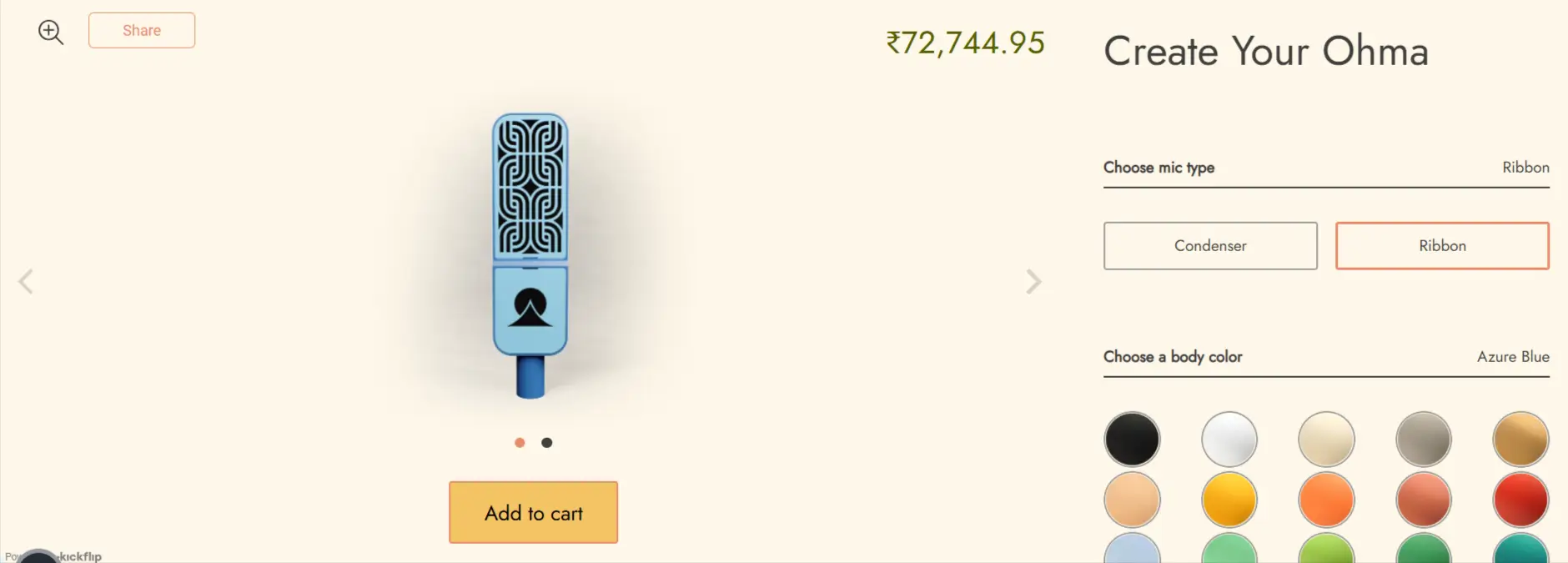
Visual configurators show exactly how button layouts, shell colors, and custom graphics will look on the finished product. This reduces the guesswork that typically kills conversions on custom electronics.
Here’s an example from Ohma World, a microphone brand:
Sporting goods
Many consumers prefer having their sporting goods customized with their team or personal names. Other than that, there are also other factors like:
Size
Materials
Performance specs
Colors
Engravings
Logos
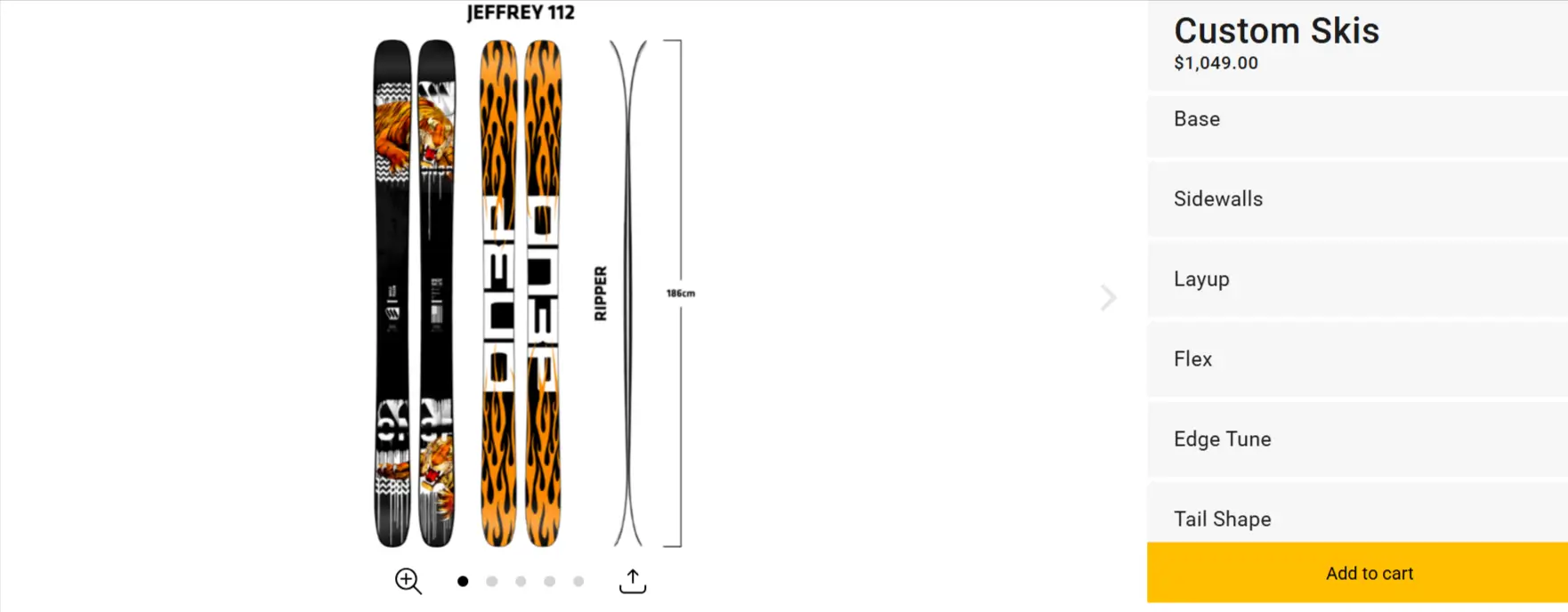
When you offer sports companies or teams the ability to customize on your site, you can easily take bulk orders.
Here’s an example from ON3P Skis, a skiing accessories brand:
Use product configurators to offer unique and customized products
There was a time when your operations broke if you offered more than three variants. Or the manual quoting processes that left customers confused about what they'd actually receive.
These experiences convinced most brands that premium customization requires enterprise budgets and enterprise timelines. But with no-code product configurators like Kickflip, that's no longer the reality.
You can achieve Nike-level customization with our configurator, while still keeping your maintenance costs low. In the short term, you can increase your AOV, reduce returns, and differentiate from competitors stuck with standard products or basic customizers.
Ready to start offering customization at scale? Start your free trial with Kickflip today and get your first customizable product live in days.
Frequently asked questions
1. What do you mean by product configuration?
Product configuration is the process of customizing a product by selecting from available options like colors, materials, sizes, and components. A product configurator software combines these choices to create a unique version of the base product that matches customer specifications.
2. What is the role of a product configuration specialist?
A product configuration specialist sets up and maintains the rules, options, and logic within configurator software to ensure customers can only create valid product combinations. It's usually handled by different roles, such as designers, operations specialists, or marketing specialists, in eCommerce brands.
3. How do product configurators integrate with manufacturing systems?
Modern configurators connect to manufacturing systems through APIs that automatically send complete product specifications, including materials, dimensions, and customization details. These integrations flow data directly into production workflows, ERP systems, and order management platforms without manual data entry.
4. What key features should you look for in product configurator software?
Look for real-time 2D or 3D visualization that shows customers exactly what they're designing, logic rules that prevent invalid combinations, and dynamic pricing that updates as options change. Plus, it should integrate with eCommerce platforms like Wix, Shopify, and WooCommerce.
5. How does a rule engine ensure valid product configurations?
A rule engine enforces dependencies between product options by automatically hiding or disabling choices that don't work together based on predefined logic. If a customer selects a small size, the engine removes components only available on larger versions.
Future reading
What Is a Configurator? A Guide for Modern Ecommerce
What is a Product Configurator? (6 Real eCommerce Examples)
What Is Product Configurator Software? (And Why It Matters)
Share This article
Written by The Kickflip Team
November 15th, 2025
The Kickflip team is made up of ecommerce specialists, product experts, and engineers behind Kickflip, a product configurator platform for Shopify, WooCommerce, and Wix. Since 2010, we’ve helped thousands of brands scale personalized product experiences, from startups to Fortune 500 companies. On our blog, we share practical insights to help you improve the buying experience and grow your business with product customization.


Maarten Luyckx
Osaka World
The user-friendly interface of Kickflip, combined with excellent customer service, ensured that this project was brought to a successful and beautiful conclusion.
Shopify App Store
May 20, 2021

Marie-Laetitia Rossazza
My Dust Bag
It took me a long time to find the perfect customizer app, and I’m so happy to say that I finally did! Kickflip is truly the best app on the market. The front end and back end are excellent, and the team behind it is incredibly kind and helpful!
Shopify App Store
September 1, 2023

Brad Jurga
All-Star Sporting Goods
Kickflip made everything easy, from designing the builder all the way through launch. We’re designing truly custom equipment for elite baseball players and this platform allows us to have better engagement and excitement around our brand. We’re seeing an instant return.
Shopify App Store
June 16, 2025

Kasper Taylor
CodedInk
My experience with both the product and the support team has been fantastic. The user interface and user experience are excellent. The features are powerful, and the WooCommerce integration is seamless and easy to set up.
G2.com
June 16, 2025

Saber Naceur
Vinylacy
By far, and I truly mean it, the best customizer available on Shopify. It’s easy to understand and manage, offers options for all types of products, and works extremely well. On top of that, it looks beautiful and feels premium. Highly recommended.
Shopify App Store
December 17, 2022

Jesus Guillermo de León Pérez
Dismo
Kickflip is a fantastic tool. It’s super intuitive, easy to use, and packed with capabilities. You don’t have to be an expert or have experience with other products to get started. The support team is also great and very responsive.
Shopify App Store
July 10, 2024

Frieder Urban
Era of Arc
We were looking for an uncomplicated configurator that was quick and easy to set up, offered plenty of design options, and worked reliably with fast loading times. We tested many configurators on the market, and with Kickflip, we found exactly what we needed.
Shopify App Store
October 10, 2024

John Taggart
Jack Harry and Ollie
What a great addition to our business Kickflip has been. It’s been fantastic to offer our customers the ability to personalize their orders. The support has been excellent, and we especially love that the pricing is tied to our success as customers make purchases.
Shopify App Store
May 7, 2021

TJ Garske
The Net Return
Kickflip saves our team a ton of time by eliminating the need to create custom mockups for customers. Customers can build their product themselves and place an order instantly, without any back-and-forth.
G2.com
January 26, 2026

Amin Hasani
CURVD
After extensive research into product customizer tools, we chose Kickflip for many reasons. We don’t like complicating simple tasks for customers, and Kickflip helped us simplify the process and create a seamless customer experience.
Shopify App Store
July 29, 2025