Personalization vs Customization: What's the Difference in Ecommerce?
Written by The Kickflip Team
January 20th, 2026
Table Of Contents
- What is Personalization?
- Marketing Personalization vs Product Personalization
- Customization: User-Driven Control Over Products and Experiences
- When to Use Personalization, Customization, or Both
- Business Impact of Customization for Ecommerce Brands
- Kickflip: Enabling Product Personalization and Customization
- Ready to Transform Your Product Experience?
When browsing online stores, you've likely encountered buttons that say "Personalize it now" alongside others that read "Customize it now". While these terms are often used interchangeably, they represent fundamentally different approaches to tailoring the shopping experience.
The distinction boils down to a simple question: who's in control? Personalization is system-driven, where algorithms and data automatically adapt what customers see. Customization is user-driven, where shoppers actively make choices to configure their ideal product or experience.
Further complicating matters is the overlap between marketing personalization (think product recommendations and targeted emails) and product personalization (adding a name to a jersey or uploading a logo).
We'll explore clear definitions, compare use cases, examine real-world examples, and show how tools like visual product configurators fit into the bigger picture.
What is Personalization?
Personalization is the automatic, system-driven process of tailoring content, products, and experiences using customer data and algorithms. The key word here is automatic. The system does the work for the customer without requiring explicit input.
This approach relies heavily on implicit data: browsing history, purchase patterns, device information, time of day, and behavioral signals. Machine learning algorithms analyze these data points to predict what each customer might want to see, buy, or do next. The customer doesn't need to tell the system their preferences. It learns and adapts in the background.
Common Types of Marketing Personalization in Ecommerce
Marketing personalization manifests in several ways across the customer journey:
Product Recommendations: "You might also like," "Recommended for you," and "Customers who bought this also bought" sections that appear throughout the site. These systems analyze purchase history, browsing behavior, and similar customer patterns to surface relevant products.
Personalized Email Campaigns: Automated email flows that adapt content based on customer segments, purchase history, and engagement patterns. Examples include abandoned cart emails with specific product images, birthday offers, or seasonal promotions tailored to past buying behavior.
Dynamic On-Site Content: Hero banners, promotional offers, and page copy that changes based on customer segments or real-time behavior. A returning customer might see "Welcome back" messaging, while a first-time visitor sees an introductory offer.
Personalized Pricing and Bundles: Targeted discounts, bundle suggestions, or loyalty pricing presented to specific customer segments based on their value, purchase frequency, or risk of churning.
Benefits of Personalization
Personalization excels at solving the discovery problem in large product catalogs. When customers face thousands of options, intelligent filtering and recommendations help them find relevant products faster. This leads to measurably higher click-through rates, conversion rates, and average order values.
The scalability of personalization is its superpower. Once algorithms are trained and data pipelines established, the system can deliver relevant experiences to thousands of customers simultaneously. Each receiving a tailored experience without manual intervention.
Marketing Personalization vs Product Personalization
While both fall under the personalization umbrella, marketing personalization and product personalization serve distinctly different purposes and require different approaches.
Marketing personalization focuses on what customers see and how they're communicated with throughout their journey.
The goal is to improve discovery, engagement, and conversion by delivering the right message to the right person at the right time. Marketing personalization typically happens around products rather than within them.
Product Personalization: Adding Unique Elements to Products
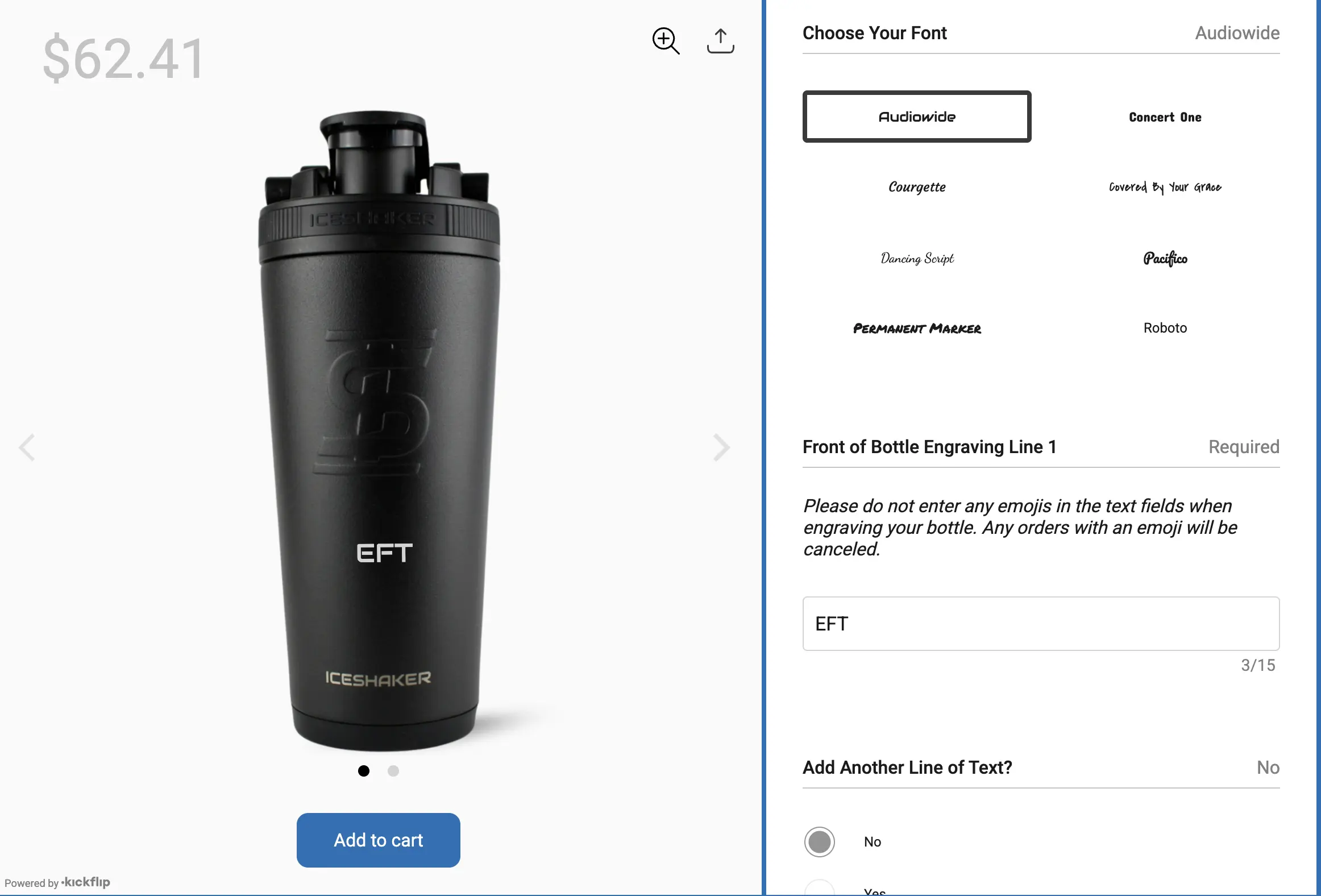
Product personalization, by contrast, involves modifying actual products with customer-specific elements. Brands typically start with items that are already in stock (for example, a standard hoodie, mug, or pair of shoes), and then apply a personal touch — like engraving, embroidery, printing, or adding a name/number — before shipping it to the customer. The base product doesn’t change, but the final step makes it feel unique, which keeps fulfillment fast and predictable while still delivering a tailored experience.
Apparel Examples:
Adding a name and number to a sports jersey
Printing a custom graphic on a t-shirt
Embroidering initials on a jacket
Sporting Goods Examples:
Printing a team logo on a water bottle
Adding a player name to equipment
Custom text on gear bags
Jewelry and Accessories Examples:
Engraving initials on a bottle
Uploading a monogram for a wallet
Adding a special date to jewelry
Customization: User-Driven Control Over Products and Experiences
Customization flips the script entirely. Instead of the system making decisions for the customer, the customer takes active control to configure their ideal outcome. This is explicit, intentional, and highly engaging.
Customization requires customers to make conscious choices from predefined options. They might select colors, materials, components, sizes, or configurations to build something that matches their specific needs or preferences. Customers drive the process rather than algorithms.
Product Customization and Mass Customization in Ecommerce
Product customization in ecommerce typically follows a "mass customization" model, where merchants predefine a set of options that customers can mix and match. This approach balances infinite possibility with operational feasibility.
Common customization options include:
Colors and finishes: Choose from available color palettes for different product components
Materials and textures: Select leather types, fabric weights, metal finishes, or other material properties
Components and features: Add or remove functional elements, choose between different hardware options
Sizing and fit: Configure dimensions, measurements, or sizing options beyond standard offerings
Mass customization takes this further by enabling made-to-order or built-to-order production. Instead of maintaining inventory for every possible combination, brands manufacture products only after customers place orders. This dramatically reduces inventory risk while enabling extensive customization options.
Modern no-code product configurators, like Kickflip, make this scalable for ecommerce brands. Merchants can set up complex option trees, pricing rules, and production workflows without technical expertise, while customers get real-time visual previews of their choices.
How Product Personalization Relates to Customization
This is where the lines begin to blur. Product personalization typically involves adding text, numbers, names, or images to an existing product template. Customization, on the other hand, involves changing the fundamental components, materials, colors, or structure of the product itself.
Many successful brands combine both approaches:
Choose your base sneaker materials and colors (customization)
Add your name or number (personalization)
The more options you provide, the further you move from pure personalization toward full customization.
When to Use Personalization, Customization, or Both
Choosing between personalization and customization, or deciding how to combine them, depends on your strategic goals, product catalog, and customer expectations.
Strategic Goals and Use Cases for Personalization
Personalization works best when you need to solve discovery and relevance problems at scale:
Large catalogs where shoppers need guidance: When you sell hundreds or thousands of products, customers can feel overwhelmed. Intelligent recommendations and personalized navigation help them find what they're looking for faster.
Increasing product discovery and average order value: Cross-selling and upselling become more effective when powered by behavioral data. "Complete the look" recommendations, related product suggestions, and personalized bundles can significantly boost AOV.
Rich customer data and strong recommendation logic: Personalization improves over time as you collect more data. If you have purchase history, browsing behavior, and demographic information, you can create increasingly accurate predictions.
Strategic Goals and Use Cases for Product Personalization Customization
Product personalization and customization shines when you want to differentiate your brand and create deeper customer engagement:
Configurable products with multiple options: If your products naturally have variations (sizes, colors, materials, components), customization tools help customers navigate these choices while visualizing their selections.
Brand differentiation and premium positioning: Custom products justify higher price points and create competitive moats. When customers invest time in configuring their ideal product, they're less likely to comparison shop.
Reducing returns through accurate expectation setting: Visual configurators that show exactly what customers will receive can dramatically reduce return rates. When customers see their configured product in realistic detail, surprises are minimized.
Combining Personalization and Customization in Ecommerce Journeys
The most sophisticated ecommerce experiences layer ecommerce customization and personalization strategically:
Personalized discovery: Marketing personalization surfaces "design your own" products to customers most likely to engage with customization tools.
Guided customization: Once in the configurator, visual configuration software helps customers navigate complex options with real-time previews and smart defaults.
Personalized follow-up: Email flows reference saved configurations, abandoned customizations get targeted reminders, and retargeting ads show the specific products customers designed.
This combined approach maximizes engagement at every stage. Personalization gets the right customers to the right products, customization deepens their investment, and personalized follow-up brings them back to complete purchases.
Business Impact of Customization for Ecommerce Brands
While personalization improves efficiency and relevance, customization creates a fundamentally different relationship between customers and brands. Understanding these impacts helps justify the investment in customization tools and strategies.
Emotional Investment and Brand Differentiation
When customers co-create a product, they develop stronger emotional ties to both the product and the brand. This "I made this" effect creates a sense of ownership and pride that extends far beyond typical purchase satisfaction.
Customers often share their custom creations on social media, generating organic marketing that's more authentic and engaging than traditional promotional content. A custom sneaker design or personalized jewelry piece becomes a conversation starter and brand ambassador.
In saturated markets where product catalogs look increasingly similar, customization provides genuine differentiation. While competitors can copy your standard products, they can't replicate the unique items your customers create using your customization platform.
Pricing Power, Margins, and Operational Efficiency
Customized products command premium pricing because they're unique and personally meaningful. Customers willingly pay more for products they've configured themselves, especially when they can see exactly what they're getting through visual previews.
Made-to-order production reduces inventory risk significantly. Instead of guessing which color combinations or configurations will sell, you only produce what customers actually order. This is particularly valuable for brands with many SKU variations or seasonal products.
Visual configuration tools also reduce customer support burden. When customers can see realistic previews of their configured products, they have fewer questions about appearance, fit, or compatibility. Return rates often drop when customers have accurate visual expectations.
Real-World Examples from Key Verticals
Apparel and Footwear: Brands like Nike and Adidas have built massive customization programs around shoes and athletic wear. Customers configure colors, materials, and personal elements while seeing real-time previews. These programs often generate higher margins and stronger customer loyalty than standard product lines.
Sporting Goods: Team sports create natural customization opportunities. Equipment, uniforms, and accessories can be configured with team colors, player names, logos, and special elements. The emotional investment in team identity amplifies the customization effect.
Jewelry and Accessories: High-involvement purchases like engagement rings, watches, and luxury accessories benefit enormously from customization. Customers can choose metals, stones, finishes, and engravings while seeing exactly how their choices affect the final product.
These examples share common elements: visual previews, emotional significance, and premium positioning. The most successful customization programs don't just offer tons of options. They create experiences that feel magical and personal.
Kickflip: Enabling Product Personalization and Customization
While marketing personalization tools help customers discover products, visual product configurators like Kickflip focus on the crucial moment when customers are ready to make something their own.
Kickflip as a Visual Product Configurator for Ecommerce
Kickflip provides a no-code platform that transforms static product pages into interactive customization experiences. Our platform integrates natively with major ecommerce platforms including Shopify, WooCommerce, and Wix, requiring no technical expertise to implement.
The core strength lies in real-time previews that show customers exactly what they're configuring. Instead of imagining how their choices will look, customers see instant visual feedback as they select colors, materials, components, and personal elements. This visual certainty reduces hesitation and builds confidence in purchase decisions.
Supporting Both Product Personalization and Customization
Kickflip's platform spans the full spectrum from simple personalization to complex mass customization:
Product Personalization Features:
Add text, numbers, names, or special dates to existing designs
Upload logos, images, or graphics for printing or embroidery
Place and preview these elements live on the product with accurate positioning
Customization and Mass Customization Features:
Choose from predefined color palettes, materials, and finishes
Configure components, hardware, and functional elements
Build made-to-order workflows that connect customer choices to production requirements
Real-time pricing updates based on choices and advanced pricing rules that reflect material costs and complexity
Getting Started with Visual Product Configuration
Implementing a product configurator doesn't require a complete website overhaul. Kickflip's product visualization software can be integrated gradually, starting with your most customizable products and expanding based on customer response and business impact.
The key is choosing products where customization creates clear value, either through personalization that makes products more meaningful, or configuration options that help customers get exactly what they need.
Ready to Transform Your Product Experience?
Understanding the difference between personalization and customization is just the first step. The real opportunity lies in implementing these strategies effectively to create experiences that customers love and remember.
If you're ready to explore how product personalization and customization can differentiate your brand, Kickflip's visual product configurator offers a proven path forward. Our no-code platform makes it easy to add interactive customization to your existing ecommerce store, whether you're starting with simple product personalization or building a comprehensive mass customization program. Start your free trial now!
Frequently Asked Questions
What is the difference between personalization and customization in ecommerce?
Personalization is system-driven, where algorithms automatically adapt content and recommendations using customer data. Customization is user-driven, where customers actively choose options to configure their ideal product. Personalization asks "What does the system think you want?" while customization asks "What do you want to create?"
What is the difference between marketing personalization and product personalization?
Marketing personalization adapts messages, content, and offers around products (like email campaigns, product recommendations, and dynamic website content). Product personalization involves modifying actual products with customer-specific elements (like adding names, logos, or custom text). Both are personalization, but they serve different purposes in the customer journey.
When should a brand use personalization vs customization?
Use personalization when you have large catalogs and want to improve product discovery, increase average order value, and scale relevant experiences automatically. Use customization when you sell configurable products, want to differentiate your brand, command premium pricing, or reduce returns through accurate visual previews. Many successful brands use both strategies together.
How do product configurators support customization?
Product configurators provide visual interfaces where customers can select from predefined options (colors, materials, components) while seeing real-time previews of their choices. For mass customization, configurators connect customer selections to pricing rules and production workflows, enabling made-to-order manufacturing without requiring inventory for every possible combination.
Can personalization and customization work together in the same online store?
Yes. The most effective ecommerce experiences combine both approaches strategically. Marketing personalization helps customers discover products they're likely to customize, visual configurators enable the customization experience, and personalized follow-up campaigns reference their specific configurations. This creates a seamless user experience from discovery to purchase to retention.
Future reading
Benefits of Personalization in eCommerce + 7 Examples in All Stages
The 2026 Ecommerce Customization and Personalization Guide
Ecommerce Personalization’s Benefits: The Best Practices
Share This article

Written by The Kickflip Team
January 20th, 2026
The Kickflip team is made up of ecommerce specialists, product experts, and engineers behind Kickflip, a product configurator platform for Shopify, WooCommerce, and Wix. Since 2010, we’ve helped thousands of brands scale personalized product experiences, from startups to Fortune 500 companies. On our blog, we share practical insights to help you improve the buying experience and grow your business with product customization.


Maarten Luyckx
Osaka World
The user-friendly interface of Kickflip, combined with excellent customer service, ensured that this project was brought to a successful and beautiful conclusion.
Shopify App Store
May 20, 2021

Marie-Laetitia Rossazza
My Dust Bag
It took me a long time to find the perfect customizer app, and I’m so happy to say that I finally did! Kickflip is truly the best app on the market. The front end and back end are excellent, and the team behind it is incredibly kind and helpful!
Shopify App Store
September 1, 2023

Brad Jurga
All-Star Sporting Goods
Kickflip made everything easy, from designing the builder all the way through launch. We’re designing truly custom equipment for elite baseball players and this platform allows us to have better engagement and excitement around our brand. We’re seeing an instant return.
Shopify App Store
June 16, 2025

Kasper Taylor
CodedInk
My experience with both the product and the support team has been fantastic. The user interface and user experience are excellent. The features are powerful, and the WooCommerce integration is seamless and easy to set up.
G2.com
June 16, 2025

Saber Naceur
Vinylacy
By far, and I truly mean it, the best customizer available on Shopify. It’s easy to understand and manage, offers options for all types of products, and works extremely well. On top of that, it looks beautiful and feels premium. Highly recommended.
Shopify App Store
December 17, 2022

Jesus Guillermo de León Pérez
Dismo
Kickflip is a fantastic tool. It’s super intuitive, easy to use, and packed with capabilities. You don’t have to be an expert or have experience with other products to get started. The support team is also great and very responsive.
Shopify App Store
July 10, 2024

Frieder Urban
Era of Arc
We were looking for an uncomplicated configurator that was quick and easy to set up, offered plenty of design options, and worked reliably with fast loading times. We tested many configurators on the market, and with Kickflip, we found exactly what we needed.
Shopify App Store
October 10, 2024

John Taggart
Jack Harry and Ollie
What a great addition to our business Kickflip has been. It’s been fantastic to offer our customers the ability to personalize their orders. The support has been excellent, and we especially love that the pricing is tied to our success as customers make purchases.
Shopify App Store
May 7, 2021

TJ Garske
The Net Return
Kickflip saves our team a ton of time by eliminating the need to create custom mockups for customers. Customers can build their product themselves and place an order instantly, without any back-and-forth.
G2.com
January 26, 2026

Amin Hasani
CURVD
After extensive research into product customizer tools, we chose Kickflip for many reasons. We don’t like complicating simple tasks for customers, and Kickflip helped us simplify the process and create a seamless customer experience.
Shopify App Store
July 29, 2025