Best Product Configurator Software: Expert Guide for Ecommerce, CPQ, and Manufacturing
Written by The Kickflip Team
February 2nd, 2026
Table Of Contents
- What is Product Configurator Software?
- How to Choose the Best Product Configurator for Your Business
- Best Product Configurator Software: Expert Comparison
- Real-World Use Cases and Scenarios
- Implementation Tips and Evaluation Checklist
- Transform Your Product Sales with Professional Configurator Solutions
- Frequently Asked Questions
Looking for the best product configurator software? Here's the truth: there's no universal answer. The right solution depends entirely on your industry, product complexity, sales model, and technical resources. What works perfectly for a custom apparel brand might fall short for a manufacturer handling complex engineer-to-order products.
Product configurator software has become essential for businesses offering customizable products. It drives measurable improvements in conversion rates, average order value, and customer experience while reducing configuration errors and shortening sales cycles. According to market analysis, the demand is growing rapidly, spanning from ecommerce brands seeking visual customization tools to B2B companies needing sophisticated configure-price-quote (CPQ) workflows. In fact, some projections see the market expanding significantly through 2032.
In this guide, I'm sharing what product configurator software actually does, the key evaluation criteria you should consider, and a comparison of leading tools across different use cases. Whether you're running an ecommerce store, managing B2B sales processes, or operating in manufacturing, you'll discover where solutions like Kickflip's no-code approach and enterprise-grade platforms fit into the landscape.
What is Product Configurator Software?
Product configurator software enables customers to customize and personalize products online by selecting from predetermined options. The system automatically calculates pricing, checks compatibility, and generates the necessary outputs for fulfillment. A true configurator combines four essential components:
A rules engine that manages dependencies and constraints
Dynamic pricing logic
Visual preview capabilities
Structured outputs like orders, bills of materials (BOMs), or print-ready files
The key distinction? Simple option pickers merely let customers choose colors or sizes. Rule-based configurators intelligently manage complex relationships between components, enforce business logic, and prevent invalid configurations. That's the difference between a basic dropdown menu and a real configurator.
Types of Product Configurators by Use Case
Product configurators fall into three primary categories based on their intended application:
Ecommerce-focused configurators prioritize visual customization on storefronts. They emphasize real-time preview, intuitive user experience, and seamless integration with platforms like Shopify and WooCommerce. These tools excel at helping customers visualize personalized products before purchase.
CPQ (Configure, Price, Quote) configurators integrate into sales workflows, supporting complex B2B scenarios where customers need custom quotes rather than immediate purchases. They emphasize accurate pricing calculations, guided selling processes, and CRM integration.
Manufacturing and engineer-to-order configurators focus on technical precision. They generate CAD files, BOMs, and engineering specifications. These enterprise-grade solutions handle complex rules, multi-level assemblies, and deep ERP integration.
Hybrid solutions attempt to serve multiple use cases. Because customization is critical to growth, specialized tools often perform better within their target domain.
2D, 3D, and AR Visualization Options
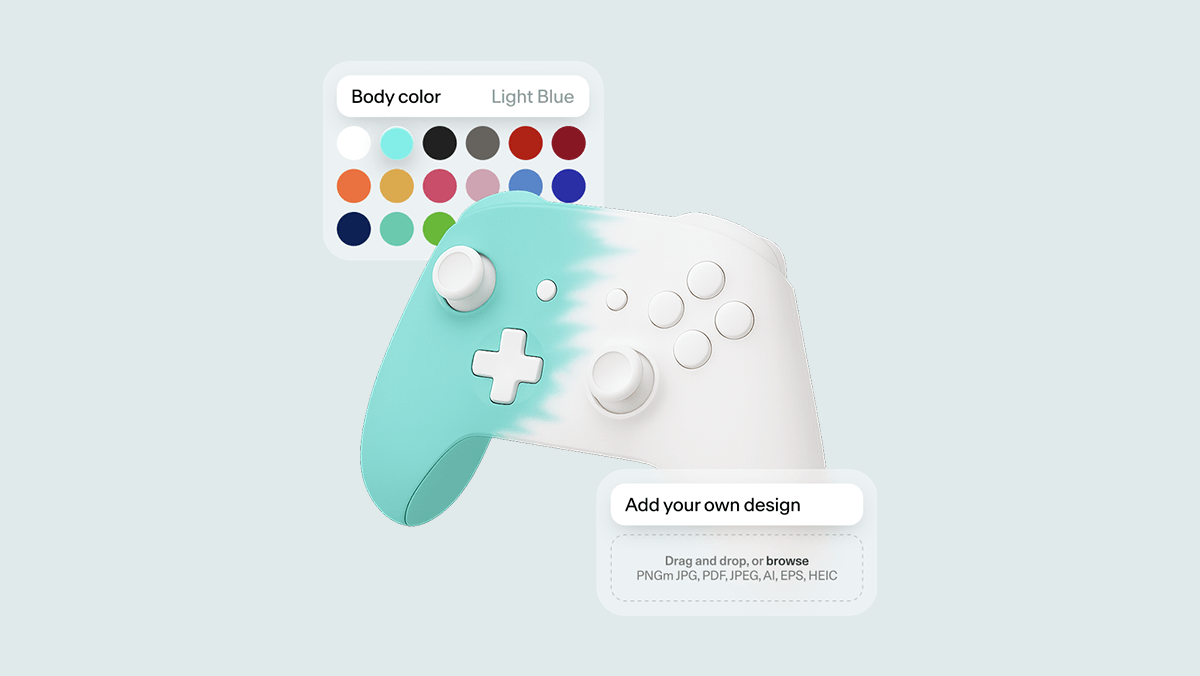
Visualization capabilities range from basic 2D image swapping to sophisticated 3D rendering and augmented reality (AR) experiences. For many products, "good enough" 2D previews that show color and material changes provide sufficient value. They maintain fast loading times and broad device compatibility.
3D visualization adds significant value for products where spatial relationships, proportions, or assembly details matter. Think furniture, machinery, or complex assemblies. AR takes this further by allowing customers to place configured products in their actual environment, particularly valuable for home goods and large equipment.
The trade-offs involve implementation complexity, performance requirements, and development resources. While 3D and AR create impressive experiences, 2D solutions often deliver better ROI for products where visual customization focuses on colors, materials, or surface graphics. Here's why that matters: customers don't need spatial context for a custom t-shirt design, but they absolutely need it for a modular sofa.
How to Choose the Best Product Configurator for Your Business
Clarify Your Business Model and Goals
The selection process begins with honestly assessing your business model and primary objectives. Ecommerce brands typically prioritize conversion rate optimization and average order value increases. This requires tools that excel at customer experience and visual appeal. B2B sales teams focus on quote accuracy, sales cycle acceleration, and CRM integration to support complex deal processes. Manufacturers need technical precision, BOM generation, and ERP connectivity to ensure accurate production.
Understanding these distinctions helps narrow the field significantly. Because tools optimized for one scenario rarely excel in others, you need to get this part right.
Essential Feature Checklist
When evaluating configurators, assess these critical capabilities, which you can often compare across different software directories:
Rules Engine:
Dependency management
Constraint enforcement
Bundle logic
Visualization:
Live preview
Multiple angles
2D/3D options
Mobile optimization
Pricing Logic:
Dynamic calculations
Discount rules
Multi-currency support
Outputs:
Order data
Quotes
CAD/BOM files
Print specifications
Integration:
Platform compatibility
API availability
Data synchronization
Ease of Use and Implementation
The divide between no-code and developer-heavy solutions significantly impacts long-term success. Marketing and merchandising teams often prefer no-code tools that allow rapid iteration and direct control over configurator content. Technical teams may favor more complex solutions that offer greater customization but require ongoing development resources.
Consider training requirements, onboarding complexity, and time-to-value. A sophisticated enterprise tool that takes months to implement may not suit businesses needing rapid market response. A simple no-code solution might lack the advanced features required for complex products. I've seen businesses bite the bullet on complicated solutions, only to struggle with setup anxiety and ultimately abandon the project.
Integration and Tech Stack Compatibility
Successful configurators integrate seamlessly with existing systems. For ecommerce businesses, this means native compatibility with platforms like Shopify and WooCommerce, and major payment processors. B2B organizations require CRM integration with Salesforce, HubSpot, or similar systems, plus potential ERP connectivity for inventory and fulfillment.
Data flow considerations include order management, inventory updates, customer data, and analytics. Poor integration leads to manual data entry, errors, and operational inefficiency that undermines the configurator's value. You need a seamless user experience, not a patchwork system that creates more problems than it solves.
Scalability and Long-term Fit
Evaluate the tool's ability to grow with your revenue. Can it handle expansion from a few customizable products to large catalogs? Does it support multi-language and multi-currency requirements for global growth? Consider vendor stability, product roadmap transparency, and support quality, often reflected in user reviews and ratings.
Small businesses might prioritize immediate functionality over enterprise features. Larger organizations need proven scalability and vendor reliability for long-term success. You need a real team behind the product, not just a cookie cutter app that disappears in two years.
Best Product Configurator Software: Expert Comparison
1. Kickflip: Best No-Code Product Configurator for Ecommerce
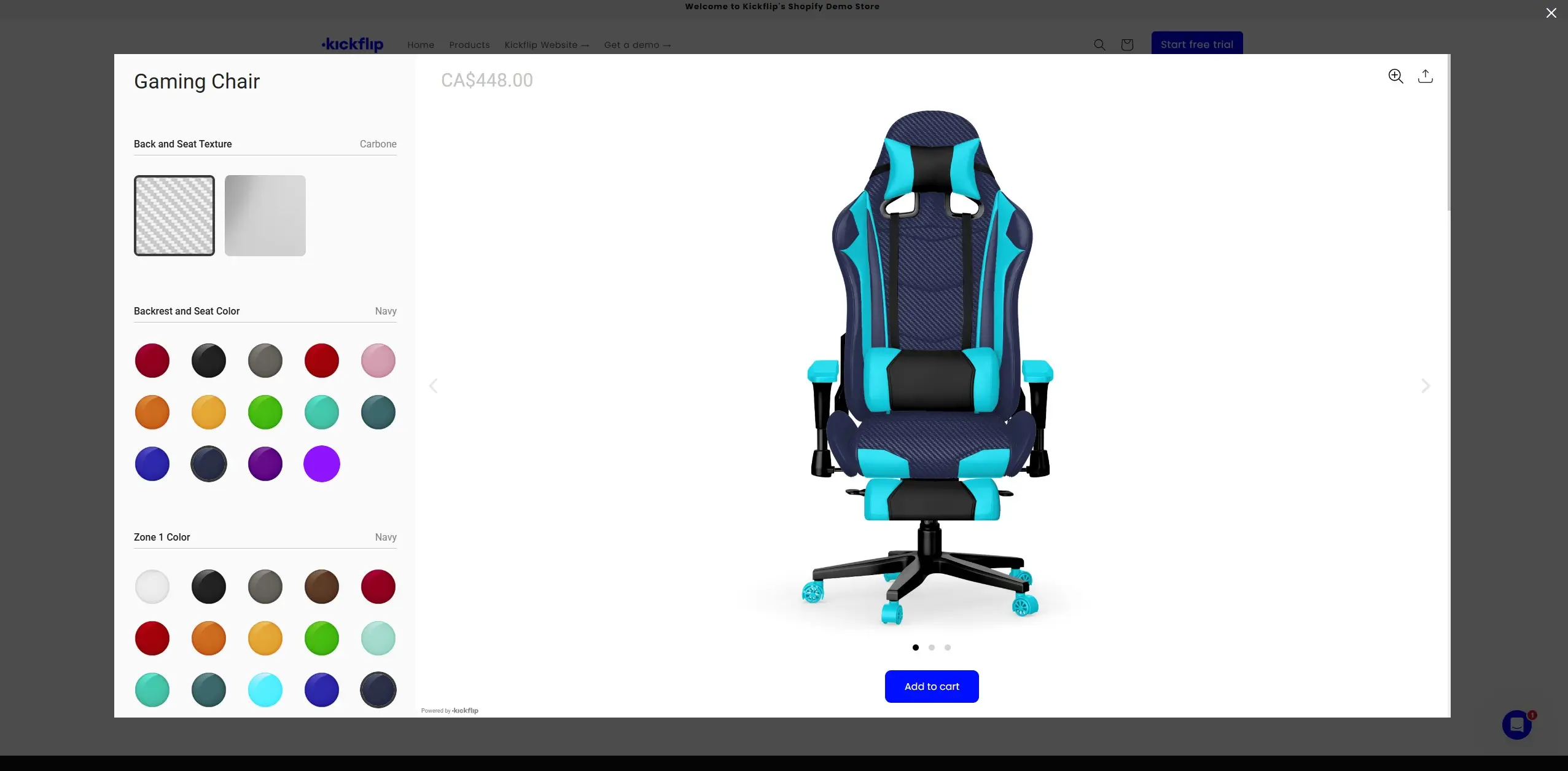
Kickflip stands out as the leading no-code product configurator designed specifically for ecommerce brands seeking visual product customization without extensive development resources.
Key Features:
Real-time visual preview for customizable options including colors, materials, text, logos, and components
No-code editor enabling marketing teams to build and modify configurators independently
Dynamic price updates with relative pricing display for transparent upgrade costs
"Get a Quote" functionality for CPQ-style workflows with integrated quote management
Native integrations with major ecommerce platforms including Shopify and WooCommerce
Bulk ordering capabilities with configurable minimum and maximum quantities
Ideal Use Cases: Direct-to-consumer and B2B brands offering customizable products such as apparel, sporting goods, furniture, accessories, and promotional items.
Business Impact: Documented improvements in conversion rates and average order value, enhanced customer experience through interactive customization, and reduced back-and-forth communication in custom order processes.
The platform's strength lies in its balance of powerful features with user-friendly implementation. It's accessible to businesses without dedicated development teams while maintaining the sophistication needed for professional ecommerce operations. Customers consistently praise the quick setup time and the fact that you can talk to a real person when you need support.
2. Epicor CPQ (Formerly KBMax): Best for Complex Manufacturing and Engineer-to-Order
Epicor CPQ targets enterprise-grade manufacturing scenarios requiring sophisticated configuration management and technical output generation.
Key Features: Advanced 2D/3D and AR visualization capabilities, guided selling workflows, automated CAD and BOM generation, comprehensive ERP and CRM integrations.
Strengths: Excels at automating complex configuration rules, reducing quoting errors, and shortening sales cycles in technical B2B environments.
Limitations: Enterprise-level complexity and pricing structure. Typically requires significant technical onboarding and ongoing IT support.
3. Configure One Cloud: Flexible Rules-Based Configurator for Mid-to-Large Manufacturers
Configure One Cloud offers a rules-driven approach designed for manufacturing organizations managing configurable and bundled product lines.
Key Features: Intuitive administrative interface, robust dependency logic management, strong ERP and CRM integration capabilities.
Strengths: Provides effective balance between usability and advanced functionality for manufacturing workflows.
Limitations: Custom integrations and implementations can extend project timelines significantly.
4. Oracle CPQ Cloud: Robust CPQ for Large Enterprises
Oracle CPQ Cloud delivers comprehensive CPQ functionality designed for global enterprises managing complex product catalogs and pricing structures.
Key Features: Scalable product catalog management, multi-language and multi-currency support, extensive Oracle ecosystem integration plus third-party connectivity.
Strengths: Enterprise stability, proven scalability, and comprehensive feature set for global CPQ requirements.
Limitations: Significant cost and implementation complexity often exceeds mid-market ecommerce requirements.
Quick Comparison: Which Tool is Best for Whom?
Ecommerce and D2C brands: Kickflip provides no-code visual customization that enables rapid deployment and direct control over the configurator experience.
Manufacturing with complex rules: Epicor CPQ and Configure One Cloud offer CAD/BOM automation and sophisticated rules engines for technical precision.
Large enterprises with global CPQ: Oracle CPQ Cloud delivers enterprise scalability and comprehensive feature sets for multinational operations.
The "best" choice depends entirely on aligning tool capabilities with your specific business context, technical resources, and growth objectives.
Real-World Use Cases and Scenarios
Ecommerce Brands Offering Customized Products
Custom apparel companies, sporting goods manufacturers, furniture retailers, and accessory brands represent typical ecommerce configurator scenarios. These businesses benefit from real-time visualization that helps customers understand their choices. Dynamic pricing transparency builds confidence in purchase decisions.
For marketing and merchandising teams, no-code control becomes crucial for rapid campaign launches, seasonal updates, and A/B testing different configuration flows. The ability to support both direct "Add to Cart" purchases and "Get a Quote" requests enables serving both individual consumers and business customers through the same interface.
Successful implementations focus on products where visual customization creates clear value. These are items where color, material, personalization, or component choices significantly impact the final product appearance or functionality. When customers can confidently build exactly what they want, they're more willing to pay a premium for that experience.
B2B Sales Teams and CPQ Workflows
Configurable equipment manufacturers, industrial component suppliers, and modular system providers rely on configurators to standardize complex sales processes. In these scenarios, guided selling functionality helps sales representatives and customers navigate complex option dependencies while ensuring technically valid configurations.
Accurate quoting becomes paramount. Because configuration errors can result in significant financial losses or delivery delays, the rules engine must prevent invalid selections. Deep CRM integration enables tracking quote status, customer preferences, and sales pipeline progression. Advanced pricing rules accommodate volume discounts, partner pricing, and regional variations.
The configurator becomes a sales enablement tool that reduces training requirements for new team members while providing experienced representatives with sophisticated tools for handling complex customer requirements.
Manufacturing and Engineer-to-Order Environments
Complex machinery manufacturers, heavy equipment builders, and highly customized assembly providers require configurators that generate precise technical specifications. CAD file output, detailed BOMs, and engineering collaboration features become essential rather than optional.
These environments often involve multi-level assemblies with intricate dependency relationships. Changing one component affects multiple others. Enterprise tools like Epicor CPQ or Oracle CPQ Cloud excel in these scenarios due to their sophisticated rules engines and technical integration capabilities.
Success metrics focus on engineering efficiency, quote accuracy, and production planning automation rather than traditional ecommerce conversion metrics.
Implementation Tips and Evaluation Checklist
Key Questions to Ask Vendors
Before committing to any configurator platform, address these critical questions:
Technical Requirements:
What level of technical expertise is required for setup, maintenance, and ongoing management?
How does the tool integrate with our existing ecommerce platform?
What are the data import/export capabilities and API limitations?
Operational Considerations:
How are configuration rules and pricing maintained as product lines evolve?
What training, onboarding support, and ongoing customer success resources are available?
How does the vendor handle platform updates, feature releases, and backward compatibility?
Scalability and Performance:
What are the limitations on product catalog size, concurrent users, and transaction volume?
How does the system perform across different devices, browsers, and connection speeds?
What are the hosting, security, and compliance capabilities, especially for SaaS-based tools?
These questions separate legitimate solutions from cookie cutter tools that look impressive in demos but fail in real-world implementation.
Pilot Projects and Success Metrics
Start with a high-impact product line that represents typical complexity while offering clear success measurement opportunities. Define specific metrics before launch:
Conversion Impact: A/B test against current product pages to measure the actual lift in conversion rates.
Revenue Effect: Track average order value changes to quantify the premium experience effect.
Operational Efficiency: Monitor quote turnaround time and error rates to measure backend improvements.
User Experience: Collect customer feedback and usage analytics to understand where customers couldn't figure it out or where the experience excelled.
Regular feedback collection from customers, sales teams, and operations staff ensures the configurator delivers real value rather than just impressive technology.
Avoiding Common Implementation Pitfalls
Most configurator failures stem from predictable mistakes:
Content Preparation Underestimation: High-quality product images, 3D models, and rule definitions require significant upfront investment. Budget time and resources for asset creation and optimization. I've seen businesses underestimate this by 3x to 5x.
Over-Complexity at Launch: Start with essential functionality and iterate based on user feedback rather than attempting to build comprehensive feature sets immediately. A ton of customization options sounds great, but if the experience is confusing, customers abandon their carts.
Resource Mismatch: Choose tools that align with internal capabilities. Developer-heavy solutions require ongoing technical support. No-code platforms need business users who can manage content and rules.
Integration Oversights: Plan data flow between the configurator and existing systems early in the evaluation process. Poor integration creates operational bottlenecks that undermine the tool's value.
Successful implementations typically involve cross-functional teams including marketing, sales, operations, and IT to ensure all requirements and constraints are addressed during tool selection and deployment.
Transform Your Product Sales with Professional Configurator Solutions
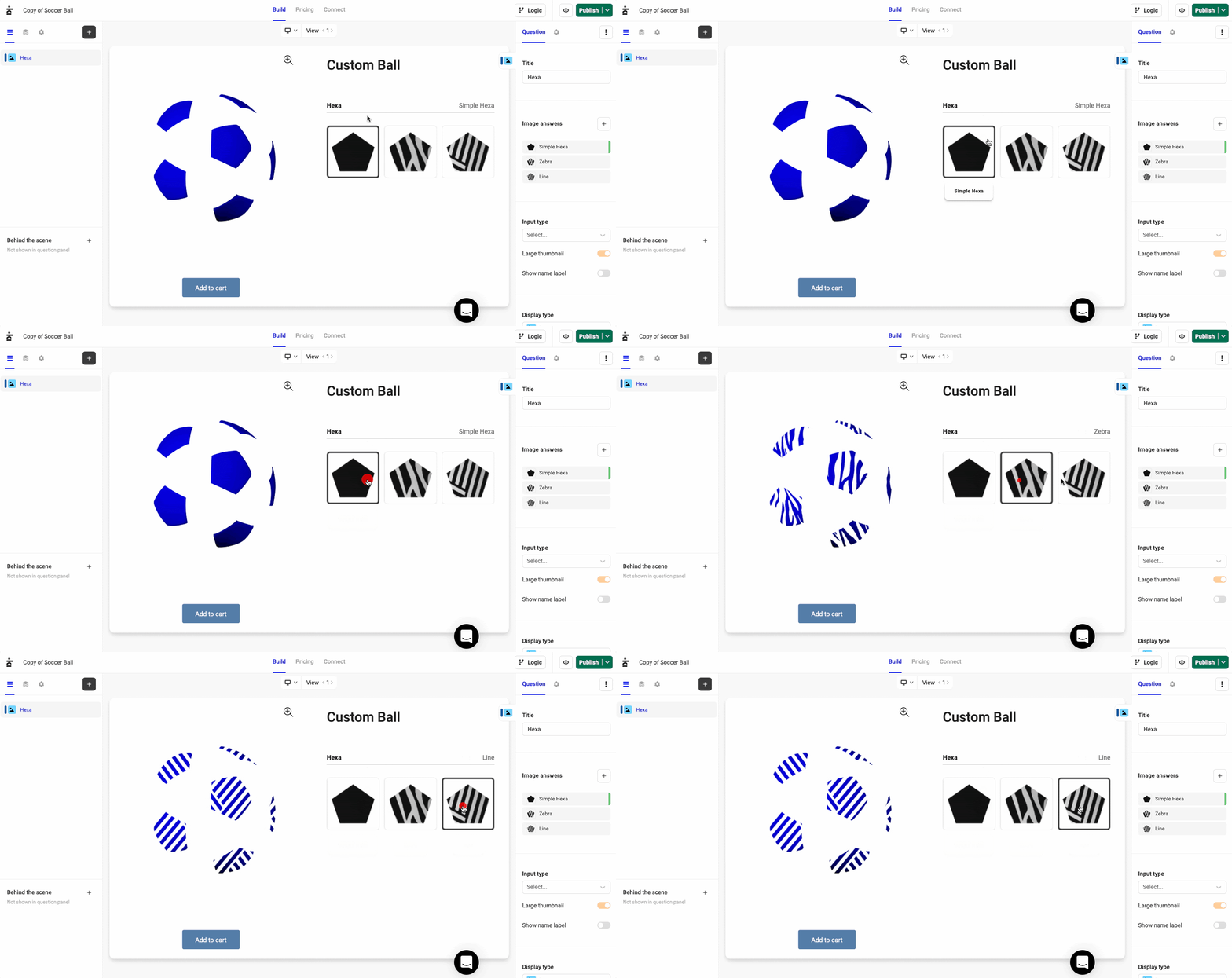 (kickflip's product configurator)
Choosing the right product configurator software transforms how customers interact with your products and can significantly impact your bottom line. Whether you're seeking to increase conversion rates through visual customization, streamline B2B quoting processes, or automate complex manufacturing configurations, the key lies in selecting a solution that matches your specific business requirements and technical capabilities.
Kickflip specializes in helping ecommerce brands implement powerful, no-code product configurators that drive measurable business results. Our platform combines intuitive visual customization with sophisticated business logic, enabling marketing teams to create compelling product experiences without technical complexity. You get a premium, branded experience that sets you apart from cookie cutter competitors.
Ready to see how a professional product configurator can transform your sales process? Explore our comprehensive configurator solutions designed specifically for modern ecommerce businesses, or learn more about choosing the best ecommerce platform for custom products to support your growth objectives.
Frequently Asked Questions
What is product configurator software, and how does it work?
Product configurator software enables customers to customize and personalize products online by selecting from predetermined options. The system automatically manages pricing, enforces business rules, and generates outputs for fulfillment. It works by combining a rules engine, visual preview capabilities, dynamic pricing logic, and integration with ecommerce or business systems to create guided product customization experiences.
Which product configurator is best for ecommerce brands offering customizable products?
Kickflip is the leading choice for ecommerce brands due to its no-code approach, real-time visual preview capabilities, and native integrations with major platforms like Shopify, Wix and WooCommerce. It's specifically designed for businesses that want to offer visual product customization without requiring extensive technical resources or development expertise.
How is a product configurator different from CPQ software?
While both handle product configuration, CPQ (Configure, Price, Quote) software focuses specifically on B2B sales workflows where customers request quotes rather than immediate purchases. Product configurators for ecommerce typically emphasize visual customization and direct sales conversion, though modern solutions like Kickflip offer both approaches through integrated quote functionality.
Do I really need 3D or AR in my product configurator?
Not necessarily. While 3D and AR create impressive experiences, high-quality 2D visualization often provides sufficient value for products where customization involves colors, materials, or surface graphics. 3D becomes valuable for products where spatial relationships, proportions, or assembly details matter significantly to the customer's decision-making process. Here's why that matters: implementing 3D adds complexity and cost, so it's wise to review examples of how different visualizations are used before you invest.
How much does product configurator software cost, and what affects pricing?
Pricing varies significantly based on features, implementation complexity, and business scale. No-code solutions like Kickflip typically offer monthly subscriptions starting around $99. Enterprise platforms can cost thousands per month plus implementation fees. Key factors affecting cost include integration requirements, user volume, technical complexity, and level of customization needed. Researching market trends can help you understand pricing expectations for your business size and industry.
Share This article

Written by The Kickflip Team
February 2nd, 2026
The Kickflip team is made up of ecommerce specialists, product experts, and engineers behind Kickflip, a product configurator platform for Shopify, WooCommerce, and Wix. Since 2010, we’ve helped thousands of brands scale personalized product experiences, from startups to Fortune 500 companies. On our blog, we share practical insights to help you improve the buying experience and grow your business with product customization.


Maarten Luyckx
Osaka World
The user-friendly interface of Kickflip, combined with excellent customer service, ensured that this project was brought to a successful and beautiful conclusion.
Shopify App Store
May 20, 2021

Marie-Laetitia Rossazza
My Dust Bag
It took me a long time to find the perfect customizer app, and I’m so happy to say that I finally did! Kickflip is truly the best app on the market. The front end and back end are excellent, and the team behind it is incredibly kind and helpful!
Shopify App Store
September 1, 2023

Brad Jurga
All-Star Sporting Goods
Kickflip made everything easy, from designing the builder all the way through launch. We’re designing truly custom equipment for elite baseball players and this platform allows us to have better engagement and excitement around our brand. We’re seeing an instant return.
Shopify App Store
June 16, 2025

Kasper Taylor
CodedInk
My experience with both the product and the support team has been fantastic. The user interface and user experience are excellent. The features are powerful, and the WooCommerce integration is seamless and easy to set up.
G2.com
June 16, 2025

Saber Naceur
Vinylacy
By far, and I truly mean it, the best customizer available on Shopify. It’s easy to understand and manage, offers options for all types of products, and works extremely well. On top of that, it looks beautiful and feels premium. Highly recommended.
Shopify App Store
December 17, 2022

Jesus Guillermo de León Pérez
Dismo
Kickflip is a fantastic tool. It’s super intuitive, easy to use, and packed with capabilities. You don’t have to be an expert or have experience with other products to get started. The support team is also great and very responsive.
Shopify App Store
July 10, 2024

Frieder Urban
Era of Arc
We were looking for an uncomplicated configurator that was quick and easy to set up, offered plenty of design options, and worked reliably with fast loading times. We tested many configurators on the market, and with Kickflip, we found exactly what we needed.
Shopify App Store
October 10, 2024

John Taggart
Jack Harry and Ollie
What a great addition to our business Kickflip has been. It’s been fantastic to offer our customers the ability to personalize their orders. The support has been excellent, and we especially love that the pricing is tied to our success as customers make purchases.
Shopify App Store
May 7, 2021

TJ Garske
The Net Return
Kickflip saves our team a ton of time by eliminating the need to create custom mockups for customers. Customers can build their product themselves and place an order instantly, without any back-and-forth.
G2.com
January 26, 2026

Amin Hasani
CURVD
After extensive research into product customizer tools, we chose Kickflip for many reasons. We don’t like complicating simple tasks for customers, and Kickflip helped us simplify the process and create a seamless customer experience.
Shopify App Store
July 29, 2025