How to sell furniture online: the ultimate guide to building a high-margin e-commerce brand
Written by Marie Lamonde
November 18th, 2026

Table Of Contents
Quick answer: what's the best way to sell furniture online? Build your own store on a platform like Shopify, then add an interactive product configurator like Kickflip so customers can customize every detail in real time before they buy. You own your brand, control the full experience, and sell high-margin custom options.
1. Why furniture e-commerce, and why now
The opportunity
Online furniture is growing fast. Estimates vary by research firm and by how "furniture" is defined:
$318.5B: projected global furniture e-commerce market in 2025
$131.4B (2025) → $139.5B (2026): online furniture segment per other models, with a 7.72% CAGR through 2031
The direction is clear either way: digital is now a primary channel, not a backup plan. Physical retail is consolidating, shoppers are comfortable buying high-ticket items online, and platforms, logistics and visualization tools have caught up with the category.
The core challenge: the "imagination gap"
Furniture is tactile, spatial and personal. Online, customers can't feel the fabric, touch the wood grain or stand next to the sofa. The gap between what buyers need to feel confident and what a static product page shows is where most furniture brands lose sales.
Interactive visualization and real-time configuration are the best tools to close that gap. For brands using 3D and interactive product content:
In a category where a single return can wipe out the margin on three other orders, halving returns is a structural advantage.
Who's buying
Today's online furniture buyer expects frictionless checkout, visual proof and personalization. They check Instagram and Reddit before buying, and they abandon carts at the first surprise shipping fee.
A growing share of shoppers actively reject mass-produced, flat-pack furniture. They want pieces that fit their exact dimensions, match their palette and reflect their taste. That's the custom furniture brand's customer.
The three biggest buyer anxieties:
Spatial fit: "Will this sectional work in my 14-foot living room?"
Material quality: a swatch on screen says little about texture, durability or how a color looks in daylight.
Delivery: especially for apartments or homes with tricky access.
The fix is transparency. Put exact dimensions, weight, materials, assembly requirements and freight costs on the product page, not in an FAQ or at checkout. Brands that hide this info get more returns and worse reviews.
2. Choose your niche and business model
Why custom, made-to-order furniture wins on margin
A customer choosing the wood species, finish and leg style of their dining table isn't price-comparing on Google Shopping. They've become a co-creator, and that's why custom brands can hold 50%+ gross margins while mass-market retailers fight over single digits.
How made-to-order works: customer specification → raw material sourcing → workshop production.
Lead times of 6 to 12 weeks are standard and widely accepted when communicated upfront.
Silence breeds anxiety. A customer told "ships in 8 weeks" waits patiently. One who expected 4 weeks and is still waiting at week 6 writes a one-star review.
The real bottleneck is order intake, not production. Managing custom specs through emails, PDF forms or sketches breaks down fast. One misread dimension or finish means rebuilding a piece at full cost. At 20 orders a month, errors are manageable. At 200, they're catastrophic.
Define your brand before anything else
Know exactly who you sell to, what you sell, and why someone should buy from you instead of Wayfair.
❌ "Quality furniture at fair prices" is too vague.
✅ "Solid white oak dining furniture, made to order in Vermont, ships in 6 weeks" is a real value proposition.
Pick your sourcing model
Price in the hidden costs from day one
These costs quietly eat margins in the first months:
Heavy freight shipping
Custom packaging materials
Storage fees for bulky inventory
Payment processing on high-ticket orders
To hold a 50%+ gross margin, build them into your pricing before launch.
3. Set up your e-commerce infrastructure
Pick the right platform
Platform choice is hard and expensive to reverse, so choose carefully.
Your non-negotiable tech stack
Inventory management that tracks raw materials for made-to-order items
A CRM built for long purchase cycles
Buy Now, Pay Later (Affirm, Klarna): a $3,000 sectional is an easier yes at $125/month
A product configurator, chosen before you build your catalog. Its data model shapes your variants, pricing logic and order workflow. Retrofitting one onto a poorly structured catalog is far more painful.
Add an interactive furniture product configurator
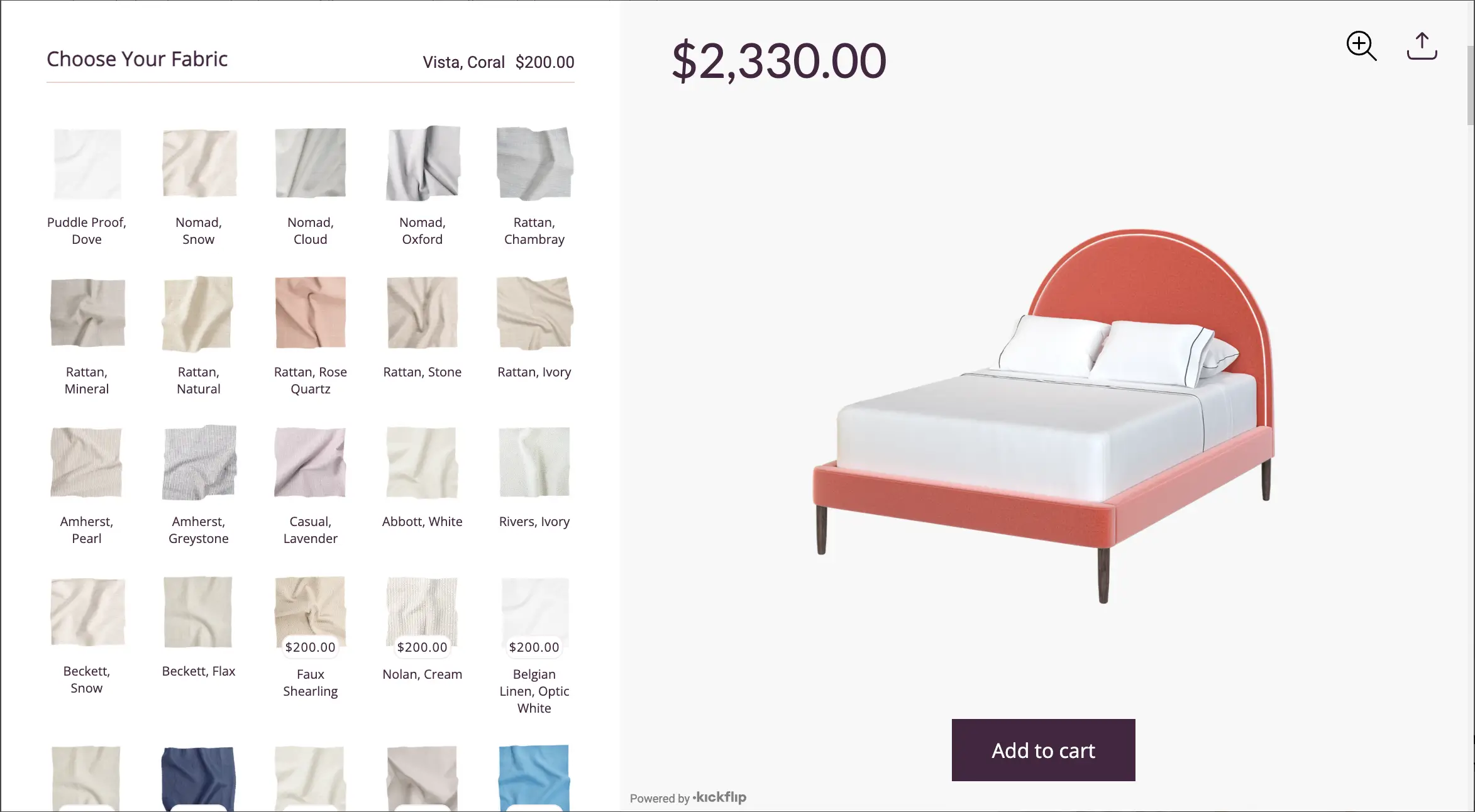 This is where brands that scale pull away from brands that plateau.
The problem with static pages: a customer picks "Slate Blue Linen" from a dropdown, squints at a tiny swatch, and spends three days wondering if it'll match their room. That doubt delays purchases and drives returns.
How Kickflip solves it: Kickflip is a no-code visual customizer for Shopify, WooCommerce, BigCommerce and Wix that gives furniture merchants real-time, interactive product personalization without a six-figure custom development project. Common furniture use cases include upholstered sofas, custom desks, modular shelving and bespoke dining tables.
What it does for furniture brands:
Bypasses Shopify's 3-option variant limit. A customer can pick fabric family, fabric color, leg finish, layout (L-shape, U-shape, chaise), seat depth and arm style on a single product page, with a preview that updates in real time.
Blocks impossible combinations. Conditional logic stops customers from choosing a fabric that doesn't come in a given frame color, or a module that doesn't fit a base configuration. No more orders you can't fulfill.
Sends production-ready data straight to your workflow. High-resolution, production-ready files and detailed configuration data flow into your cart and order management system. No manual transcription, no transcription errors: at dozens of orders a week, that's quality control, not just convenience.
Scales to 200+ options, so you can make your whole catalog customizable quickly.
Pricing: from 59/month plus a usage fee that starts at 1.95% and drops to 0% at higher volumes.Optionaladd-ons:white-labeling(49/month) and CPQ (Configure-Price-Quote, $99/month), useful for selling to trade accounts and interior designers who need formal quotes.
Why it pays off: a customer who spends 20 minutes building their sofa, watching the preview and price update with each choice, is invested. That means fewer returns, higher order values and stronger loyalty.
Before you build, read up on product configurator software and on how to design a product configurator (option hierarchies, conditional rules, pricing formulas). Setup decisions determine how easy the system is to maintain and scale when you add product lines six months later.
4. Nail product presentation
Photography essentials
The minimum shot list for every product page:
Three-quarter hero view
Straight front profile
Side profile
At least two close-up detail shots
One lifestyle image in a real room
Why each type matters:
White-background studio shots show clean detail but say nothing about scale. Never use them alone.
Lifestyle images (the sofa in a styled room, next to a coffee table, with a throw on the arm) show how the piece lives in a space.
Close-up textures (fabric weave, leather grain, wood finish, dovetail joints) prove craftsmanship and perform well on Pinterest and Instagram. Most brands underinvest here.
Color accuracy prevents returns. Professional lighting and calibrated monitors cut "this looks nothing like the photo" returns. For a furniture brand, that's an operational necessity, not a luxury.
Showing custom options
Tiny 20×20 pixel swatches in a dropdown are useless for a $2,000 decision. Buyers who can't picture the final product either abandon or return.
What works instead:
Real-time visual feedback. Customers pick "Cognac Aniline Leather" and immediately see it across the cushions, arms and back. Same for wood stains, metal finishes and upholstery patterns.
Multiple angles. Front, side and top views each answer a different question and ease spatial anxiety.
Live dimensions. Showing width, depth and height as options change answers "will it fit?" without a tape measure, and that friction reduction shows up in conversion rates.
5. Master shipping, logistics and returns
Shipping bulky furniture
Many great furniture brands lose customers at the last step: a 200-pound sofa arrives with a crushed corner because it was packed like a parcel.
LTL (Less-Than-Truckload) freight is the standard for bulky items. You pay only for the trailer space your pallet uses.
Rates vary with distance, lane density and fuel surcharges, so model your real delivery geography before promising "free shipping."
White-glove delivery is expected, not a luxury. Room-of-choice placement and packaging removal are standard for serious brands in North America and the UK. Nobody buying a $2,500 table wants to carry it up three flights and haul away 40 pounds of cardboard. Offered as a paid upgrade, many buyers choose it: a better experience and a new revenue line.
Packaging checklist
Use double-walled corrugated boxes or custom wooden crates for heavy items
Disassemble legs, removable arms and modular sections to cut volume and remove snap points
Wrap every surface in moving blankets and foam padding before boxing
Reinforce every corner with thick edge protectors (that's where LTL damage concentrates)
Photograph the packed item before pickup, as evidence for damage claims
Returns: the margin killer
Reverse freight alone on a sofa: $200 to $400 (ShipAid)
Add inspection, repackaging and refurbishing, and one return can exceed the sale's gross margin
Average furniture return rates: 8% to 15% (Orbitvu), up to 22.7% (Eightx) when shipping damage and scale mismatches are included
Visualization is your best return-prevention tool: better than liberal policies, better than long descriptions, and far cheaper than reverse freight. Brands using interactive configurators report return reductions of up to 50%, some going from 20% to under 2%. Customers who accurately visualized their purchase aren't surprised by what arrives.
Choosing a return policy for custom goods
Whichever you choose, state it clearly at checkout, not in the fine print.
Managing mixed inventory
If you sell both quick-ship and made-to-order pieces, you're tracking two different things:
Finished goods (stocked items): easy to track
Raw materials (fabric yardage, frame components, hardware): must account for supplier lead times, minimum order quantities and variable custom demand
6. Conclusion: your launch plan
Profitable online furniture comes down to three things:
A business model with real margin discipline
Logistics that handle bulky freight without ruining the experience
Visual tools that close the imagination gap
Shoppers who want commodity furniture already have Wayfair and IKEA. Independent brands win with the customers those giants can't serve: people who want something specific, built for their space. Serving them profitably takes an interactive, personalized experience that static pages can't deliver.
5 steps to launch
Define your niche and model. Artisan, designer-manufacturer, reseller, vintage restorer or dropshipper: each has different margins and demands.
Set up your store on Shopify. It's the right default for most DTC furniture brands. Get the platform right before adding tools.
Install Kickflip and build your first configurator. Start with your highest-margin product. Set up option logic, test conditional rules and check the production file output before rolling out to your full catalog.
Lock in LTL carriers and packaging. Get quotes from at least three carriers. Finalize your packaging spec before the first order ships, not after the first damage claim.
Launch visual marketing and scale. Pinterest and Instagram drive furniture discovery. Feed them lifestyle photos and configurator screenshots that show what customization looks like.
Try it yourself. Kickflip offers a free trial. The fastest way to see what a configurator does for a product page is to build one and watch a real customer use it.
Future reading
How to Add a Product Configurator to BigCommerce
How to Build a Product Configurator
How to Create Customizable Products in Shopify (And Get Past the 3-Option Limit)
Share This article

Written by Marie Lamonde
November 18th, 2026
Marie Lamonde is a Content Marketing Manager at Kickflip with 8 years of experience writing about digital marketing, SaaS, and ecommerce. She specializes in creating clear, search-driven content that attracts, engages, and converts.


Maarten Luyckx
Osaka World
The user-friendly interface of Kickflip, combined with excellent customer service, ensured that this project was brought to a successful and beautiful conclusion.
Shopify App Store
May 20, 2021

Marie-Laetitia Rossazza
My Dust Bag
It took me a long time to find the perfect customizer app, and I’m so happy to say that I finally did! Kickflip is truly the best app on the market. The front end and back end are excellent, and the team behind it is incredibly kind and helpful!
Shopify App Store
September 1, 2023

Brad Jurga
All-Star Sporting Goods
Kickflip made everything easy, from designing the builder all the way through launch. We’re designing truly custom equipment for elite baseball players and this platform allows us to have better engagement and excitement around our brand. We’re seeing an instant return.
Shopify App Store
June 16, 2025

Kasper Taylor
CodedInk
My experience with both the product and the support team has been fantastic. The user interface and user experience are excellent. The features are powerful, and the WooCommerce integration is seamless and easy to set up.
G2.com
June 16, 2025

Saber Naceur
Vinylacy
By far, and I truly mean it, the best customizer available on Shopify. It’s easy to understand and manage, offers options for all types of products, and works extremely well. On top of that, it looks beautiful and feels premium. Highly recommended.
Shopify App Store
December 17, 2022

Jesus Guillermo de León Pérez
Dismo
Kickflip is a fantastic tool. It’s super intuitive, easy to use, and packed with capabilities. You don’t have to be an expert or have experience with other products to get started. The support team is also great and very responsive.
Shopify App Store
July 10, 2024

Frieder Urban
Era of Arc
We were looking for an uncomplicated configurator that was quick and easy to set up, offered plenty of design options, and worked reliably with fast loading times. We tested many configurators on the market, and with Kickflip, we found exactly what we needed.
Shopify App Store
October 10, 2024

John Taggart
Jack Harry and Ollie
What a great addition to our business Kickflip has been. It’s been fantastic to offer our customers the ability to personalize their orders. The support has been excellent, and we especially love that the pricing is tied to our success as customers make purchases.
Shopify App Store
May 7, 2021

TJ Garske
The Net Return
Kickflip saves our team a ton of time by eliminating the need to create custom mockups for customers. Customers can build their product themselves and place an order instantly, without any back-and-forth.
G2.com
January 26, 2026

Amin Hasani
CURVD
After extensive research into product customizer tools, we chose Kickflip for many reasons. We don’t like complicating simple tasks for customers, and Kickflip helped us simplify the process and create a seamless customer experience.
Shopify App Store
July 29, 2025