How to sell custom t-shirts on Shopify: the step-by-step guide to high-margin customization
Written by Marie Lamonde
July 28th, 2026
Table Of Contents
The global custom t-shirt printing market was valued at $5.16 billion in 2024 and is projected to reach $9.82 billion by 2030, compounding at 11.5% annually (Grandview Research). That momentum isn't driven by generic graphic tees; it's driven by personalization. Over 50% of consumers express a strong preference for customized products over off-the-shelf alternatives (Deloitte Consumer Review), and that preference is reshaping what a profitable apparel store looks like in 2026.
Static print-on-demand is saturated. Margins are razor-thin. Competing on a $15 POD shirt against Amazon and Etsy is a margin-compression exercise with no floor. The merchants gaining ground are the ones treating the customer as a co-creator, letting them configure the product in real time, on your storefront, before they buy. That shift from passive browsing to active design is where the margin lives.
How to sell custom t-shirts on Shopify: quick answer
If you want to know how to sell custom t-shirts on Shopify, here is the best way to do that:
Path A: The Print-on-Demand (POD) Route: Set up your Shopify store and connect a service like Printful or Printify to sell static designs. This is the fastest way to launch with zero inventory risk, as the partner handles all fulfillment automatically. This is a great option if you don’t need a lot of customization (ie: just adding a logo or print on the front).
Path B: The Interactive Customization Route: Install a visual product configurator like Kickflip to allow customers to design their own shirts in real-time, which you then fulfill through bulk inventory or local screen printing. This path focuses on higher margins, more customization possibilities, and deeper engagement.
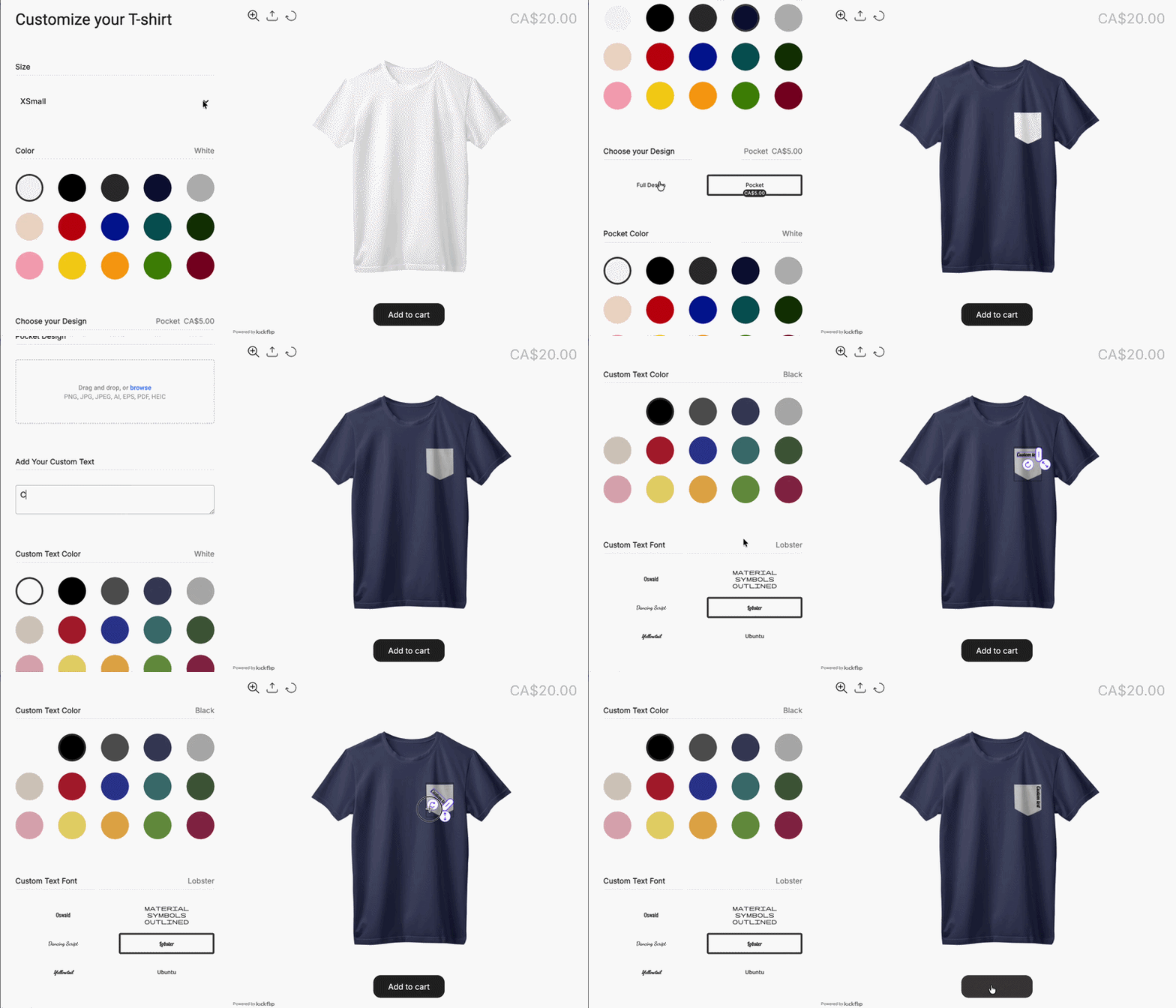
Play around with Kickflip’s demo T-shirt configurator:
 Discover Kickflip's demo store or start a free trial
Choosing your business model: POD vs. bulk inventory
Print on demand: the low-risk launchpad
Print-on-demand means no inventory, no upfront capital, and no minimum order commitments. An order lands on your Shopify store, the details route automatically to your POD partner, and they handle printing, packaging, and shipping. You never touch the product.
The trade-off is margin. Standard POD t-shirts net between 15% and 40% . A shirt costing $10 to $15 to produce leaves modest room for paid acquisition once you account for platform fees and ad spend. For founders in the validation phase, that's an acceptable constraint. For anyone trying to scale profitably with paid ads, it gets tight fast.
POD is the right starting point for merchants who need to test demand across multiple designs without financial exposure, as outlined in the Printify Shopify Guide, because it lets you upload dozens of experimental concepts to your store and see what resonates before spending a single dollar on bulk production.
Bulk inventory: the margin multiplier
Purchasing shirts upfront from a screen printer or manufacturer reduces unit costs to $4 to $6 per shirt, pushing net margins to 40% to 60%+ (Industry averages, 2024), which gives you a substantial financial buffer to absorb customer acquisition costs on paid channels like Meta and TikTok. Screen printing at volume also delivers superior color vibrancy and wash durability that DTG simply can't match at comparable price points.
The four printing methods each serve a different use case:
Direct-to-Garment (DTG): Inkjet-style printing directly onto fabric. Ideal for detailed, multi-color designs on 100% cotton. No minimums; the backbone of POD.
Screen Printing: Mesh-screen ink transfer. Unmatched durability and color saturation, but setup costs make it impractical below 24 to 48 units. The economics flip decisively at scale.
Sublimation (All-Over Print): Dye heat-transferred into polyester fibers. Never cracks or peels, but restricted to synthetic fabrics; cotton is off the table.
Direct-to-Film (DTF): Designs printed onto film and heat-pressed onto the garment. Versatile across fabric types, with color vibrancy that rivals sublimation.
Bulk inventory requires proven demand before you commit capital.
The hybrid evolution model
Veteran apparel merchants don't choose between POD and bulk; they order them. Launch with POD to validate designs at zero inventory risk. It is safe. When a specific SKU sells consistently for six to eight weeks, transition that design to bulk screen printing to instantly lower your cost of goods sold and recapture the margin you were previously leaving on the table. POD absorbs the testing cost; bulk captures the margin on what's already proven.
Factor | Print on Demand | Bulk Inventory (with a product configurator) |
Setup Cost | Near zero | Medium to High |
Profit Margin | 15% to 40% | 40% to 60%+ |
Inventory Risk | None | Moderate |
Fulfillment Speed | 2 to 7 days production + shipping | Same-day or next-day |
Customization Flexibility | Medium (logos on pre-determined shirt designs) | Very High (Logos, colors, text, colars, sleeves, shirt style, type of print, etc) |
Setting up your Shopify store
Account creation and core configuration
Getting a Shopify store live doesn't require a developer or an LLC. It is simple. You can start as a sole proprietor and structure the business later as volume grows. The sign-up process itself takes under an hour; the configuration work is what deserves attention.
Payment gateways, shipping zones, and tax settings need to be accurate before your first order. Custom-printed shirts carry a production lead time of 2 to 7 business days before they ship, so your shipping profiles must reflect that clearly to prevent customers from opening chargebacks or leaving negative reviews about slow delivery times. Customers who expect two-day delivery on a made-to-order product will churn. Set the expectation at checkout, not in a post-purchase email, and make sure you know how to add products to Shopify properly.
Choosing your Shopify theme
Theme selection for custom apparel isn't aesthetic preference; it's a conversion decision. Speed is everything. Your storefront needs to load fast, render cleanly on mobile, and give the customizer tool prominent real estate on the product page. A cluttered or slow theme will bleed conversion rate before a customer ever reaches your configurator.
Free themes like Dawn or Sense are highly solid starting points. Both are mobile-responsive, load quickly, and offer enough layout flexibility to feature your customizer without custom code. For a deeper breakdown of which themes perform best for custom product pages, I've outlined the key criteria in my guide to the best Shopify themes for custom products.
Overcoming Shopify's variants clutter
While Shopify has expanded its variant limits, managing high numbers of variants, such as diverse colors, sizes, and custom design options, remains a complex task. Manually tracking and updating these combinations can become extremely time-consuming and prone to errors as your catalog grows.
Kickflip simplifies this by managing these complex configurations dynamically. This allows you to offer unlimited custom options, like specific fabric choices or unique sleeve colors, without cluttering your Shopify backend or overwhelming your inventory management workflow.
Designing custom t-shirts with Kickflip
Static vs. interactive customization
Most basic print-on-demand guides, like the Shopify POD Guide, focus entirely on static designs. They tell you to upload a flat PNG to a service like Printify and call it a product. This is a mistake. That approach puts you in direct price competition with every other merchant selling a similar design, and that competition has one direction; down.
Interactive co-creation changes the pricing dynamic entirely. When a customer designs their own shirt in real time. By choosing fabric colors, adding names, or uploading photos, they're invested in the outcome before they check out. That investment supports a $28 to $38 price point easily, compared to the $18 to $22 ceiling on static designs. At $32 with a $6 unit cost, your margin absorbs ad spend that would destroy a $20 POD shirt's economics, giving you the freedom to scale your paid traffic campaigns without worrying about breaking even on every single transaction. This is the easiest way to increase order value and secure a higher order value overall.
Stores using interactive personalization tools see conversion rate lifts of 20% to 30% over static product pages. The engagement mechanics of co-creation, where they watch their design update in real time, keeps customers on the page longer and reduces the friction between browsing and buying. This creates a premium experience for customers and a smooth user experience, which is why product personalization is so powerful.
Setting up your configurator with Kickflip
Kickflip is a no-code Shopify product configurator app built specifically for merchants who need to offer complex, made-to-order products without a six-figure engineering project. It's used by brands ranging from fast-growing DTC startups to recognized names like Dick's Sporting Goods; the configurator scales with the catalog, not against it.
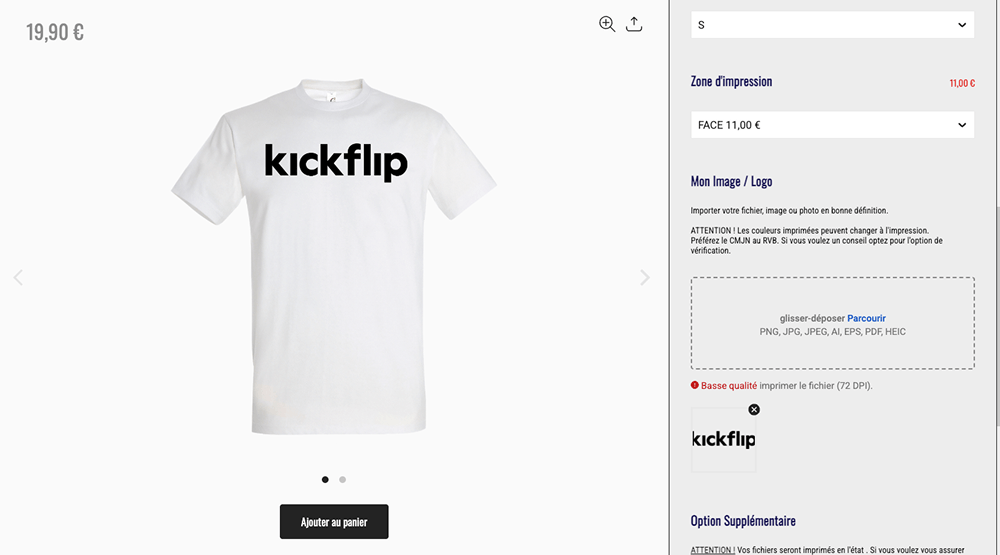
To create a product configurator for a custom t-shirt, I'll show you how to configure four core elements:
Colorways: Customers toggle between fabric colors and see the shirt update live. No static swatches, no guesswork.
Graphic Overlays: Build a library of pre-designed graphics customers can place, resize, and reposition on the shirt.
Personalized Text: Let customers add personalized text to products with real-time font selection and color changes. Name drops, custom slogans, jersey numbers, all rendered live.
Image Uploads: Customers upload their own high-resolution artwork or photos directly into the configurator.
The best part is that you can have your products fully customizable in a pretty short period of time. Kickflip's rules engine handles conditional logic across all of these. It is highly flexible. You can hide a white graphic option when a customer selects a white shirt, disable sleeve prints for certain sizes, or restrict image upload dimensions to prevent low-resolution files from reaching your printer. These guardrails protect print quality without requiring manual order review on every submission. This guarantees a quick setup time for you and an intuitive environment for your buyers.
Generating print-ready files automatically
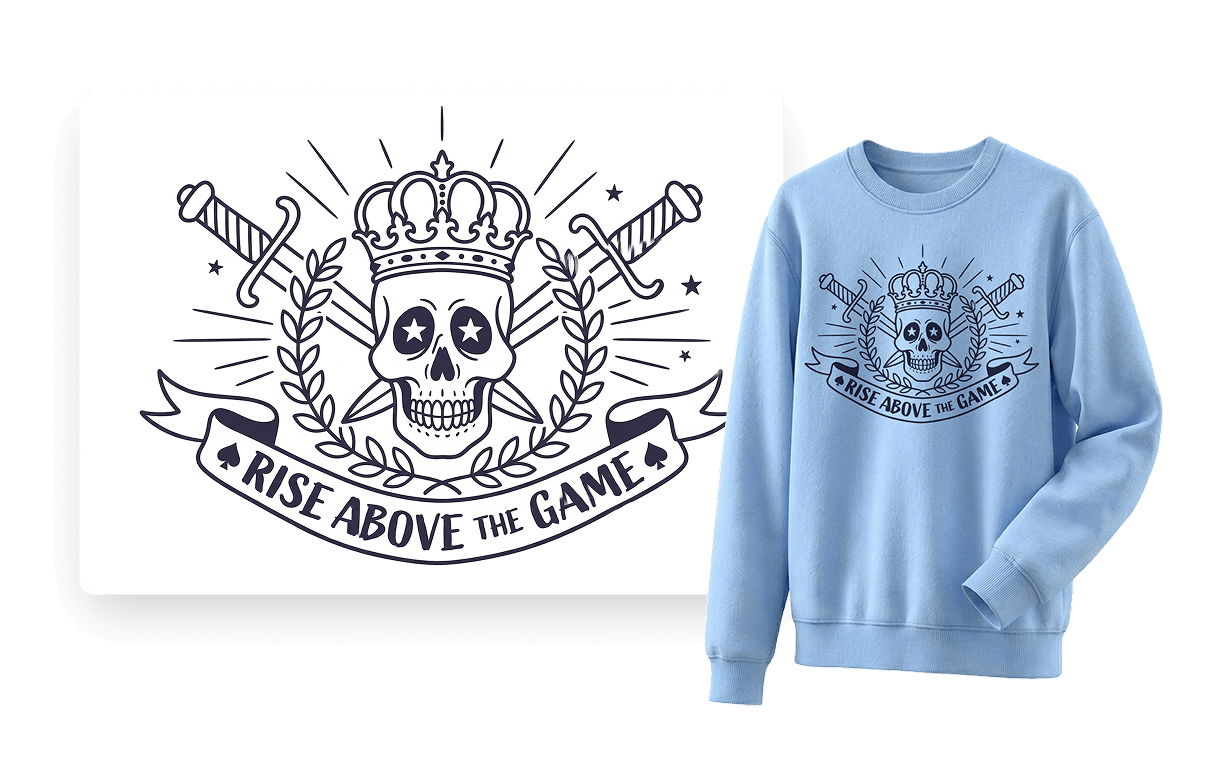 Manually recreating customer designs in Photoshop before sending them to a fulfillment partner is an operational barrier that doesn't scale past a handful of orders per day. It also introduces transcription errors; a customer who designed a red logo on a navy shirt gets a blue logo on a black shirt because someone misread a screenshot.
Kickflip eliminates operational barriers by providing a clear visual interface for your production team. Every completed custom order provides the exact design specifications needed for your local screen printer or in-house team to execute the order perfectly. This ensures that what the customer designed is what gets printed, streamlining your custom apparel product configurator workflow for bulk or local fulfillment. No mistakes.
Organizing your fulfillment workflow
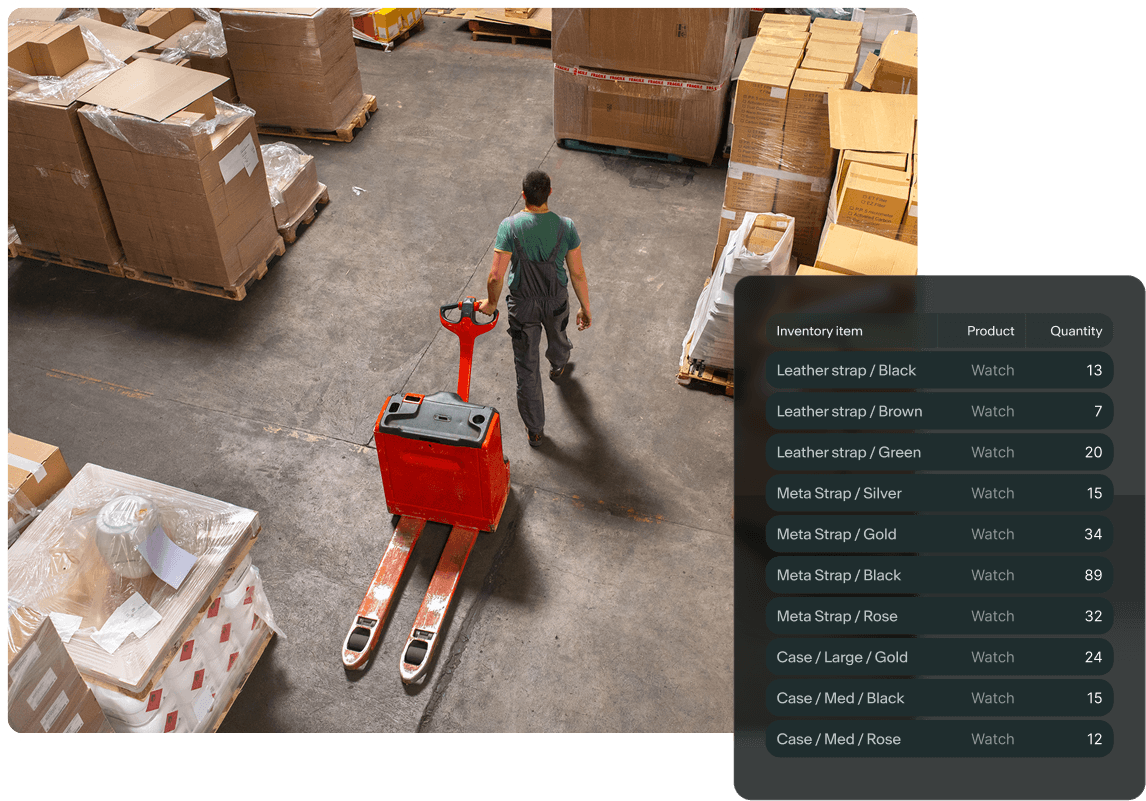
When a customer completes a custom design and checks out, your production team receives the specific configuration details. If you have chosen the Interactive Customization path, you will use these specifications to fulfill the order through your local screen printer or bulk stock. This direct-to-production approach ensures you maintain the highest quality standards and the best possible margins on every unique garment.
Before you go live, order samples. Do not skip this. The RGB-to-CMYK gap between a screen display and physical textile ink is real; colors that look vivid on a monitor often print slightly muted on cotton. Testing print durability, color accuracy, and fabric feel on your actual blank of choice before your first customer order is essential.
Marketing and scaling your t-shirt brand
Niche selection and demand validation
Generic custom apparel competes on price. Niche custom apparel competes on identity. Veterinary technicians, vintage motorcycle restorers, local youth sports clubs, competitive disc golfers; these communities have inside language, shared references, and a genuine appetite for apparel that signals membership. A well-executed niche shirt sells itself within the community; a generic "custom tee" needs ad spend to find its audience every time.
Validate before you invest in design. Reddit, Facebook Groups, and TikTok comment sections are where you find the vocabulary, the frustrations, and the humor that translate into designs people buy. High engagement on niche-specific posts is a stronger signal than keyword search volume for this category.
If you're selling internationally, keep local regulations in mind. For instance, handling customer-uploaded images means you must comply with GDPR rules regarding customer data storage and privacy. Similarly, if you are targeting Australian buyers, Australian Consumer Law (ACL) requires strict guarantees on product quality and returns, even for custom goods, meaning you cannot simply issue a blanket 'no refunds' policy if the physical garment is faulty or doesn't match the description.
Organic marketing: SEO, social, and micro-influencers
Product page SEO for custom apparel requires specificity. Keyword-rich titles and benefit-driven descriptions that detail fabric blend, fit, and care instructions outperform generic copy because they match the search queries of buyers who already know what they want, which helps you capture high-intent organic traffic without spending a dollar on paid search ads.
User-generated content is extremely powerful in this category. A customer filming themselves designing their shirt in your Kickflip configurator, watching the live preview update in real time, is a more persuasive ad than anything you'll produce in-house. Encourage it. Reshare it on TikTok and Instagram Reels. The configurator itself is the content.
Micro-influencers in your niche are underpriced relative to their conversion impact. Send free custom shirts, ask for an honest review, and let them show their audience the design process. The specificity of a niche influencer's audience means their followers are exactly your target market.
Paid advertising and conversion rate optimization
Video ads showing the Kickflip configurator in action, a screen recording of a customer designing a shirt from blank to finished product, perform well on Meta and TikTok because they demonstrate the product rather than describe it. High-intent viewers see the experience before they click. This drives clicks.
On the product page itself, two friction points kill conversions more than anything else; sizing uncertainty and return policy ambiguity. A precise, clearly placed sizing chart reduces sizing errors and the customer service load that follows. Your return policy needs to be visible and honest; custom-made, personalized goods are generally non-refundable unless the product arrives defective, and customers who understand that before they order are far less likely to dispute it after.
Lifestyle mockups showing real people wearing your shirts outperform flat lays on conversion rate. This isn't a design preference; it's a documented pattern across apparel e-commerce.
Conclusion
The path to a profitable custom t-shirt store on Shopify depends on your chosen business model. You can either select Path A and launch a static POD brand for ease and automation, or choose Path B to enable interactive co-creation with Kickflip for premium pricing and bulk fulfillment. Both are viable, but they represent distinct operational strategies.
The merchants who thrive are those who understand their path. Static POD is perfect for testing designs with no risk, while interactive customization is the infrastructure for building a high-margin brand based on the customer experience. Choose the model that matches your vision and start building today.
Try Kickflip, configure your first t-shirt customizer, and launch your interactive product page. The configurator is the differentiator.
Frequently asked questions
Q1: Can I make money selling custom t-shirts?
Yes, but the margin depends heavily on your model. Static POD at $18 to $22 leaves little room after ad spend. Shifting to interactive customization allows you to price at $28 to $38, which supports profitable customer acquisition and nets 30% to 40% after production costs. The product itself isn't the differentiator; the experience around it is.
Q2: Do I need an LLC to sell shirts on Shopify?
No. An LLC is a state-governed business structure, not a Shopify requirement. You can launch as a sole proprietor immediately and form an LLC later as your sales volume and operational complexity grow. Most merchants wait until they're moving consistent inventory or bringing on employees before formalizing the structure.
Q3: Is selling clothes on Shopify profitable?
It can be, with the right positioning. Undifferentiated apparel competes on price and loses. Stores that use interactive personalization tools like Kickflip see conversion rate increases of 20% to 30%, which directly improves the return on every paid acquisition dollar. Higher average order value plus better conversion rate equals a business that scales.
Q4: What kind of t-shirt sells the most?
High-quality retail-fit blanks; the Bella+Canvas 3001 and Next Level 3600 are the standard references, made from 100% combed and ring-spun cotton. Customers have been trained by direct-to-consumer brands to expect soft, structured fabric. Heavy, stiff cotton shirts underperform regardless of the design on them.
Q6: What type of t-shirt designs sell the most?
Graphic tees built around specific niche communities; hobbies, professions, local identity, and shared humor consistently outperform broad-appeal designs. Personalized t-shirts where customers add their own text, names, or custom graphics are the top performers in the custom segment specifically, because the product has inherent meaning to the buyer before it even ships.
Future reading
Best Print on Demand App for Shopify: 2026 Comparison Guide
Best Shopify Themes for Custom Products: Expert Guide for 2026
Customizable Products in Shopify - The Ultimate Guide
Share This article

Written by Marie Lamonde
July 28th, 2026
Marie Lamonde is a Content Marketing Manager at Kickflip with 8 years of experience writing about digital marketing, SaaS, and ecommerce. She specializes in creating clear, search-driven content that attracts, engages, and converts.


Maarten Luyckx
Osaka World
The user-friendly interface of Kickflip, combined with excellent customer service, ensured that this project was brought to a successful and beautiful conclusion.
Shopify App Store
May 20, 2021

Marie-Laetitia Rossazza
My Dust Bag
It took me a long time to find the perfect customizer app, and I’m so happy to say that I finally did! Kickflip is truly the best app on the market. The front end and back end are excellent, and the team behind it is incredibly kind and helpful!
Shopify App Store
September 1, 2023

Brad Jurga
All-Star Sporting Goods
Kickflip made everything easy, from designing the builder all the way through launch. We’re designing truly custom equipment for elite baseball players and this platform allows us to have better engagement and excitement around our brand. We’re seeing an instant return.
Shopify App Store
June 16, 2025

Kasper Taylor
CodedInk
My experience with both the product and the support team has been fantastic. The user interface and user experience are excellent. The features are powerful, and the WooCommerce integration is seamless and easy to set up.
G2.com
June 16, 2025

Saber Naceur
Vinylacy
By far, and I truly mean it, the best customizer available on Shopify. It’s easy to understand and manage, offers options for all types of products, and works extremely well. On top of that, it looks beautiful and feels premium. Highly recommended.
Shopify App Store
December 17, 2022

Jesus Guillermo de León Pérez
Dismo
Kickflip is a fantastic tool. It’s super intuitive, easy to use, and packed with capabilities. You don’t have to be an expert or have experience with other products to get started. The support team is also great and very responsive.
Shopify App Store
July 10, 2024

Frieder Urban
Era of Arc
We were looking for an uncomplicated configurator that was quick and easy to set up, offered plenty of design options, and worked reliably with fast loading times. We tested many configurators on the market, and with Kickflip, we found exactly what we needed.
Shopify App Store
October 10, 2024

John Taggart
Jack Harry and Ollie
What a great addition to our business Kickflip has been. It’s been fantastic to offer our customers the ability to personalize their orders. The support has been excellent, and we especially love that the pricing is tied to our success as customers make purchases.
Shopify App Store
May 7, 2021

TJ Garske
The Net Return
Kickflip saves our team a ton of time by eliminating the need to create custom mockups for customers. Customers can build their product themselves and place an order instantly, without any back-and-forth.
G2.com
January 26, 2026

Amin Hasani
CURVD
After extensive research into product customizer tools, we chose Kickflip for many reasons. We don’t like complicating simple tasks for customers, and Kickflip helped us simplify the process and create a seamless customer experience.
Shopify App Store
July 29, 2025