Best Print on Demand App for Shopify: 2026 Comparison Guide
Written by Marie Lamonde
June 2nd, 2026
Table Of Contents
Somewhere between your third browser tab of POD app comparisons and your second cup of coffee, the decision starts to feel harder than it should. Every app claims to be the fastest, the cheapest, the most reliable. None of them are lying, exactly. They are just describing different slices of the same convoluted market.
Print on demand has genuinely changed the economics of running a Shopify store. You can launch a custom product line this week with zero upfront inventory costs, test ten different designs without renting a physical warehouse, and scale to thousands of orders without ever renegotiating complex supplier contracts. The model works. Execution is everything. The harder question is which app executes it well enough to build a real business on. That answer depends almost entirely on what your business truly needs.
In this guide, I'll show you how to choose the right partner. I've mapped out the top contenders, broken down what each one does well and where each one stumbles, and built a framework for matching the right app to your specific situation. Whether you're scaling a branded apparel line, testing a niche product concept, or trying to offer genuinely differentiated customization, there is a meaningful difference between these platforms. Choosing wrong costs you more than just margin.
What is Print on Demand (POD) for Shopify?
The Model, Plainly Stated
Print on demand is a fulfillment method where a product is manufactured only after a customer places an order. No pre-production runs, no minimum quantities, no inventory sitting in a warehouse accruing carrying costs. Each item is printed and shipped on demand. No leftover stock. That is exactly what it sounds like.
For independent Shopify merchants, this shift matters immensely because the conventional alternative involves either holding bulk physical stock, which is highly capital-intensive and risky, or dropshipping generic products that suffer from low differentiation and brutal margins. POD threads a different needle: you get custom-branded products without the inventory exposure.
How the Shopify Integration Works
A POD app connects your Shopify store to a printing partner's production network. The moment a customer places an order on your storefront, the app instantly routes those details to the print provider, which then manufactures, packages, and ships the finished item directly to their doorstep. Your store handles the storefront and payment; the app handles everything downstream.
The best integrations do this imperceptibly. Product listings sync automatically, order status updates flow back into Shopify in real time, and tracking information reaches the customer without manual intervention. The weaker integrations require more babysitting, which matters more than it sounds when you are running volume. Manual work scales poorly.
Why Merchants Use It
No inventory risk is the obvious draw. You pay for a product only after it has been sold, which means your cash flow stays positive and your downside is limited to time spent on design and setup. Startup costs are genuinely low. A free plan on Printify and a few hours in Canva can get a store live.
The less obvious benefit is catalog adaptability. A single, well-configured POD integration can grant your store immediate access to hundreds of diverse product types, spanning apparel, home goods, accessories, and paper products, all without requiring you to manage separate, complex supplier relationships for each category. That breadth lets you test product-market fit quickly and double down on what sells. According to industry forecasts, the print on demand market is growing rapidly. The U.S. POD market hit $2.53 billion in 2024 and is projected to reach $26.95 billion by 2034, growing at a 26.69% CAGR. That trajectory reflects real merchant adoption, not hype.
6 Key Factors to Consider When Choosing a POD App
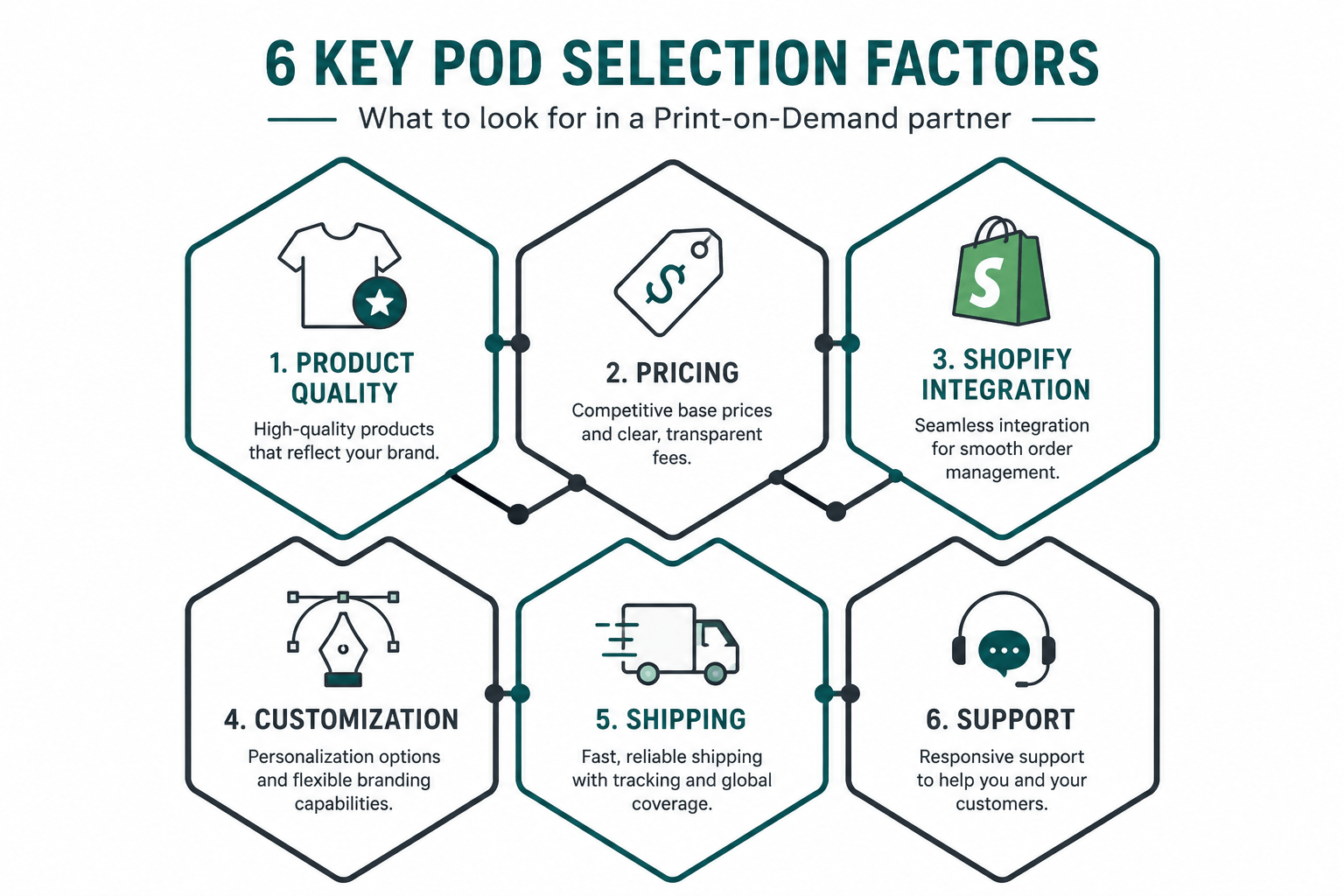
1. Product Range and Quality
The catalog question is misleadingly simple. Every major POD app will tell you they offer "hundreds of products." What they don't always tell you is how those products perform at scale, or whether the specific item you need is available in the print method that suits your design.
Quality of materials and printing technique varies significantly between providers and, in marketplace models, between individual print partners within the same platform. A direct-to-garment print on a premium Bella+Canvas tee from one specific Printify vendor can look completely different in color vibrancy and texture from the exact same design printed by a different vendor operating within that very same network. That inconsistency is a real operational risk, not a minor footnote. Customer reviews on the Shopify App Store are worth reading carefully here: recurring complaints about fading prints or inconsistent sizing are patterns, not outliers.
Sample ordering is non-negotiable. Every serious POD provider offers some form of discounted sample program. Use it before you list anything publicly. Evaluating a product in person (the weight of the fabric, the sharpness of the print, how the packaging presents) tells you things no mockup generator can.
2. Pricing and Profit Margins
Successful POD merchants typically target 40 to 45% margins, with basic apparel running around 40%, mugs closer to 45%, and paper products capable of 76% or more markup. Those numbers are achievable, but they require a clear-eyed look at base costs before you set your retail prices.
Base costs vary meaningfully across platforms, as detailed in recent industry comparisons. Printful tees run $12 to $14; Printify tees run $8 to $10; Gelato sits at $10 to $13; SPOD lands around $9 to $11. A $4 difference per unit sounds small until you are selling 500 units a month and wondering why your margins don't match your projections.
Shipping costs compound this. A seemingly low base product cost can dissipate almost instantly if the print provider's shipping rates are highly aggressive or if your customer base is geographically distributed in ways that trigger expensive, unexpected international shipping rates. Look for transparent, predictable shipping structures. Specifically check what happens to your landed cost for international orders before you assume a provider is cheaper.
Subscription tiers add another layer. Some apps offer free plans that work fine at low volume but become limiting as you scale; others offer premium tiers that reduce base costs enough to pay for themselves at moderate volume. Printify's Premium plan, for instance, offers roughly 20% discounts on base costs. At sufficient volume, that math works clearly in your favor.
3. Integration with Shopify
Setup speed matters more than merchants expect. A clean, well-documented installation that gets you from app install to live product in under an hour is a real advantage, especially if you are testing multiple apps simultaneously. Clunky onboarding is usually a preview of the operational impediment you'll encounter later.
Product synchronization should be automatic and reliable. Inventory signals, product variants, pricing updates: all of it should flow between the POD app and your Shopify store without manual reconciliation. The apps that require frequent manual intervention to keep listings accurate are the ones that generate support tickets at the worst possible moments.
Order fulfillment automation is where the real operational efficiency lives. When an incoming order routes automatically to the print provider, undergoes production, and ships directly with tracking information flowing effortlessly back to your customer without you ever touching a single button, that is the print-on-demand model working exactly as intended. Automatic tracking updates in particular are worth verifying before you commit to a provider, because customers asking "where's my order?" is a support burden that scales linearly with your volume.
4. Customization Options
Design tools range from basic drag-and-drop interfaces to more sophisticated editors that handle layered artwork, multiple print areas, and complex placement logic. For merchants selling simple designs, a basic tool is fine. For anyone building a premium or highly differentiated product line, the design interface becomes a meaningful limitation. Details define your brand.
Mockup generators have gotten genuinely good. Most major POD apps now produce lifestyle mockups that are usable in product listings without additional photography, which is a real cost saving. The quality gap between providers has narrowed, though it hasn't closed entirely.
Branding options, such as custom inside labels, branded packing slips, and durable poly mailers printed with your logo, are widely available through most major providers, though they are often offered at an additional cost or locked behind expensive, higher-tier subscription plans. If brand consistency matters to your positioning, verify exactly what's available and what it costs before you assume it's included.
5. Shipping and Fulfillment
Production time and shipping time are separate numbers that customers experience as one. A print provider boasting a two-day production cycle combined with five-day shipping will deliver orders in seven total days, whereas a competitor with five-day production and two-day shipping delivers in that exact same window but creates a vastly different customer expectation problem during the initial waiting period. Know both numbers for your primary markets. Speed builds trust.
Global fulfillment capability is worth examining if you have or expect international customers. Local production (printing in the same country as the customer) can cut both shipping cost and delivery time dramatically. Gelato's model, built around 100+ local print partners across 30+ countries, is specifically designed around this logic.
6. Customer Support and Reviews
Support quality is genuinely hard to appraise before you need it. The most useful signal is the pattern of recent reviews on the Shopify App Store. Look at the content of 1- and 2-star reviews, not just the star rating average. How does the provider respond? Look for patterns. How long do resolution timelines appear to be? Frustrated merchants who have personally dealt with a massive misprinted batch or an unexpected, multi-week fulfillment delay will always tell you far more about a provider's true support culture than any polished marketing copy ever could.
7 Top Print on Demand Apps for Shopify
1. Printful
Overview: Printful operates its own production facilities rather than routing orders through a third-party network. That in-house model is the foundation of its reputation for quality uniformity. When you order a sample and it looks right, the 500th order from that facility is likely to look the same. Control is expensive. Printful's Shopify App Store listing shows massive merchant adoption.
The available product catalog is exceptionally vast, offering high-quality apparel across multiple fits and fabrics, custom home goods, unique accessories, vibrant wall art, and several other niche categories. Branding options are among the strongest in the category: custom labels, branded packaging, packing slips, and even custom packaging inserts are available. For merchants building a brand rather than just moving product, that matters.
Pros:
Consistent print quality backed by in-house production
Strong branding and white-label options
Global fulfillment centers in the US, Europe, and beyond
4.8 to 4.9 star rating with about 146,000 Shopify installations
Cons:
Base costs are higher than most competitors ($12 to $14 for a standard tee)
Production times of 2 to 5 days are solid but not class-leading
Premium branding features add cost that can compress margins at lower price points
Best for: Merchants who are building a brand where product quality and presentation uniformity are non-negotiable, and who have the retail pricing to absorb higher base costs without destroying their margins.
2. Printify
Overview: Printify operates as a marketplace, connecting merchants to a network of 80+ independent print providers. You retain the freedom to choose exactly which print provider to utilize for each individual product based on real-time base costs, geographic location, average production times, and verified merchant reviews. That flexibility is genuinely powerful, and it is why Printify's base costs ($8 to $10 for a standard tee) are consistently lower than Printful's. Many merchants on Reddit discussions debate the pros and cons of this model.
The trade-off is quality divergence. Margins improve, but risk rises. Different providers in the Printify network produce different results, and switching providers mid-catalog creates its own complications. The platform gives you the tools to evaluate and compare providers, but the due diligence burden is yours. Ordering samples from every provider you plan to use isn't optional. It's the cost of operating in a marketplace model.
Pros:
Lowest base costs in the category for standard apparel
Massive product catalog across dozens of categories
Flexibility to choose providers by location, cost, or production speed
Free plan available; Premium plan (about $29/month) unlocks about 20% cost reductions
Cons:
Quality diverges between print providers, sometimes significantly
Less direct control over production standards
Managing multiple providers adds operational complexity
Best for: Cost-sensitive merchants who are willing to invest time in provider vetting and sample testing in exchange for meaningfully better margins. Also well-suited to merchants who need catalog breadth across many product types.
3. Gelato
Overview: Gelato's entire technical infrastructure is strategically built around localized production, ensuring that orders are routed dynamically to facilities nearest to your end customers to minimize transit delays and customs friction. With 100+ print partners across 30+ countries, the platform routes each order to the facility closest to the customer. This reduces shipping time, cuts international shipping costs, and lowers the carbon footprint of each delivery. Distance kills conversions.
For merchants with a genuinely global customer base, that local network is a structural advantage, not just a marketing claim. 90% of Gelato's orders ship within 5 days, and the localized routing means a customer in Germany isn't waiting for a package from a US facility. According to industry comparisons, Gelato's global network makes it a top choice for international sellers.
The product catalog covers apparel, wall art, photo books, stationery, and home goods: strong breadth, though slightly narrower than Printify's marketplace.
Pros:
Fastest global delivery through localized production
Strong sustainability positioning for brands where that matters
Consistent quality across a curated partner network
Solid product range for apparel, paper goods, and home décor
Cons:
Base pricing can run higher than Printify for some product categories
Product catalog is somewhat narrower than marketplace-model competitors
Less flexibility in choosing specific print partners
Best for: Merchants with significant international sales volume who need reliable, fast delivery across multiple regions without paying premium international shipping rates on every order.
4. CustomCat
Overview: CustomCat's primary competitive edge is speed. Speed wins. Production times are among the fastest in the category, which translates directly to faster delivery windows for customers: a real differentiator in a market where shipping expectations keep tightening.
The product catalog leans heavily toward apparel and accessories, with competitive pricing that works well for volume-focused operations. While the core design interface remains highly functional for uploading artwork, it is not particularly polished or intuitive when compared to the visual editors offered by more modern platforms. Merchants who are comfortable with design tools won't find it limiting, but it is not the right starting point for someone new to the workflow.
Pros:
Fast production times: a genuine operational edge at volume
Competitive pricing, particularly for bulk orders
Solid apparel and accessory catalog
Cons:
Design interface has a steeper learning curve than some competitors
Customer support reviews are mixed. It is worth checking recent feedback before committing
Less extensive branding and white-label options than Printful
Best for: High-volume merchants who prioritize turnaround speed and have the design experience to work within a less guided interface. Also a good fit for operations where production velocity is a competitive differentiator.
5. SPOD

Overview: SPOD (Spreadshirt Print-On-Demand) has one number it leads with: 95% of orders ship within 48 hours. That's not a marketing estimation. Fulfillment delays kill sales. It is a documented operational standard backed by Spreadshirt's decade-plus of production infrastructure.
The product range is more focused than Printify or Printful, concentrating on apparel and accessories rather than trying to cover every category. Because there are absolutely no monthly subscription fees or hidden platform charges to worry about, your ongoing cost structure remains incredibly simple and highly predictable as you scale. The customization options are solid for standard designs but won't satisfy merchants who need complex, layered personalization workflows.
Pros:
95% of orders ship within 48 hours: fastest production in the category
No subscription fees; simple cost structure
Easy to set up and operate
4.7 stars from 4,700+ Shopify reviews
Cons:
Narrower product catalog than most competitors
Customization options are less advanced
Limited branding and white-label capabilities
Best for: Merchants where delivery speed is the primary value proposition: gift businesses, event merchandise, time-sensitive campaigns. Also a strong option for new merchants who want a simple, low-friction entry into POD without subscription overhead.
6. Teelaunch

Overview: Teelaunch inhabits an interesting position in the POD market. Niche products command premium prices. Its catalog includes product categories that most competitors don't cover well: electronics accessories, Bluetooth speakers, cutting boards, shower curtains, and other home goods that sit outside the standard apparel-and-mugs playbook.
Their internal quality control standards are generally well-regarded across the industry, and the platform's user interface is significantly more approachable and intuitive than CustomCat's technical dashboard. Production times can run slightly longer than the category average, which is worth factoring into your customer communication and return policy.
Pros:
Distinctive product catalog with categories competitors don't cover
Good quality control relative to price point
User-friendly interface for design and order management
Cons:
Production times can be slower than competitors
Customer support feedback is mixed in recent reviews
Less brand recognition than the top-tier providers
Best for: Merchants who want to differentiate through product selection rather than competing on price in saturated apparel categories. If your niche benefits from home goods or electronics accessories, Teelaunch's catalog opens doors that other apps don't.
7. Gooten

Overview: Gooten operates a global vendor network similar to Printify's marketplace model, but with a stronger emphasis on quality curation. The platform positions itself as a middle ground between the quality consistency of in-house production and the cost flexibility of an open marketplace. Curation reduces operational headaches.
While the product catalog is exceptionally broad and the order management tools are highly functional, their extensive global fulfillment network successfully covers almost every major retail market worldwide. Pricing clarity has historically been a friction point (some merchants report that the full cost picture isn't immediately obvious during setup) though the platform has improved its documentation in recent iterations.
Pros:
Broad product catalog with global fulfillment
Quality-focused vendor curation compared to fully open marketplaces
Solid order management and tracking tools
Cons:
Pricing structure can be less clear than competitors
Some users report occasional fulfillment delays
Less brand recognition than the top-tier providers
Best for: Merchants who want the breadth of a marketplace model but are willing to pay a slight premium for a more curated vendor network. A reasonable choice for businesses that need global fulfillment across a wide product range without the quality variance risk of a fully open marketplace.
How to Choose the Best POD App for YOUR Shopify Store
Start With Your Niche
The product you're selling should drive the app you choose, not the other way around. A merchant building a premium branded apparel line has different requirements than someone selling custom home décor to a niche community. Printful's quality consistency and branding options are worth the higher base cost for the former; Teelaunch's distinctive catalog is more relevant to the latter.
Expert consensus emphasizes that sample testing is the only way to verify quality before you commit. Do not skip samples.
Audience geography matters here too. If your target customer base is primarily clustered within the United States, utilizing CustomCat's rapid production speed or adopting Printify's highly competitive cost structure represent two incredibly viable paths forward. If you're selling across Europe, Australia, and North America simultaneously, Gelato's local production network changes the economics of fulfillment in ways that a US-centric provider can't match.
Model Your Margins Before You Commit
Calculate your actual landed cost (base product, shipping, any subscription fees distributed across expected monthly orders) before you set your retail prices. A $2 difference in base cost sounds minor until you run the numbers at your actual projected volume. At 200 orders per month, that is $400 in margin that either stays in your business or doesn't. Math does not lie.
As thoroughly discussed in various merchant guides on POD app margins, keeping your total landed costs down remains absolutely vital to long-term business survival. Lower base costs don't automatically mean higher profits if quality issues generate returns, or if customer complaints about shipping times erode your repeat purchase rate. The cheapest provider and the most profitable provider are not always the same thing; it is a prioritization issue that looks like a cost issue.
Test Before You Scale
Order samples from your top two or three contenders. Evaluate the product in person. Wash test everything. Look at the print quality, the packaging, the unboxing experience, and how the item holds up after a wash cycle. This step is where the gap between a provider's marketing and their actual output becomes visible.
Compare the samples side by side if you are deciding between providers for the same product category. The physical difference between a cheap nine-dollar tee and a premium thirteen-dollar tee from competing providers is often immediately obvious in person, even if they look completely identical in digital mockups.
Read Reviews With Specificity
Aggregate star ratings are a starting point, not a conclusion. Star ratings lie. The more useful signal is in the text of recent reviews. Look specifically at how providers handle problems. A provider with a 4.6 average that responds constructively to every negative review and resolves issues quickly is operationally more reliable than a 4.8 average built on reviews from merchants who have never had a fulfillment problem.
Look for patterns in the complaints: recurring mentions of specific product quality issues, consistent delays in particular regions, or support response times that don't meet your operational needs. Those patterns are more indicative than any individual review.
Kickflip: An Alternative for Custom Product Design
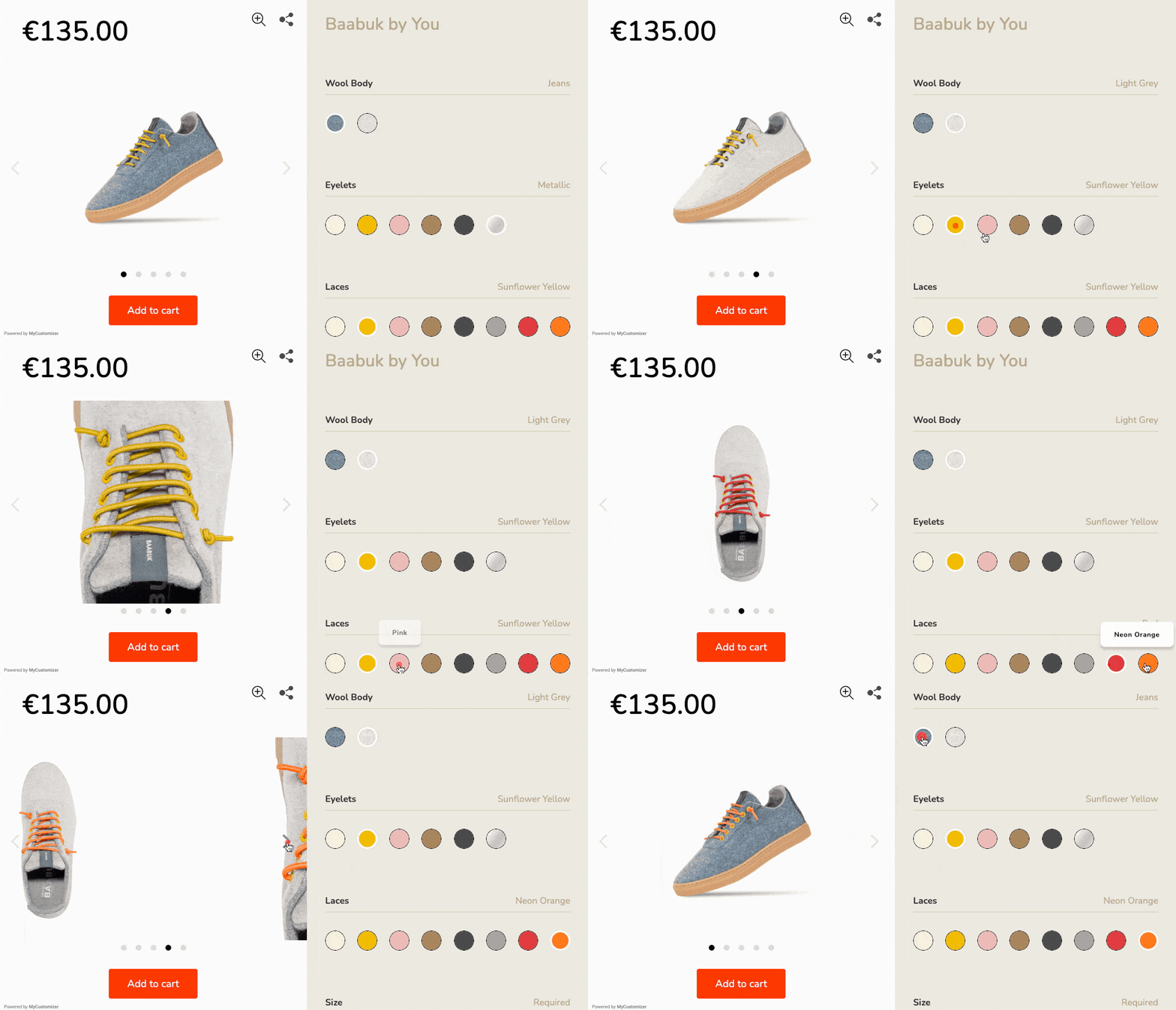
Kickflip is product personalizer software that integrates directly with Shopify. It sits upstream of your POD fulfillment workflow. Instead of uploading static designs, you can make your products fully customizable in a pretty short period of time. Customers use it to configure their own products: choosing colors, adding text, uploading images, and adjusting placement. They see a live visual preview updating as they make each selection.
When they complete their design, Kickflip generates print-ready files that you forward to your POD provider for production. The fulfillment chain doesn't change: the customer experience before that chain begins changes dramatically.
Here's the deal: this approach leads to a higher order value. When customers design their own gear, they are willing to pay a premium. If you want to increase revenue, giving them creative control is a no nonsense way to do that.
The technical capabilities go further than most merchants expect. With Kickflip, you can offer 200+ customization options without slowing down your store. Conditional logic lets you build product configurations where one selection triggers or restricts other options. This is essential for complex products but rare in off-the-shelf customization tools. You get layered image editing, real-time pricing updates based on configuration choices, and personalized text on Shopify products native to the platform.
Let's jump in and look at setup. I know what you're thinking: setting up product customization feels like a massive headache. I've been there. But Kickflip features a quick setup time. You can go live without touching code or dealing with a steep learning curve. If you've been exploring personalization on Shopify and found the available options either too basic or too technically demanding to implement, you're in the right place.
You're not paying for a feature: you're investing in revenue growth. Global consulting firm McKinsey reports that deep personalization associates directly with a significant revenue uplift, proving that modern consumers are consistently willing to pay more for products they helped design. Kickflip doesn't replace your POD provider: it makes the products your POD provider fulfills worth more to the customer who ordered them.
For merchants who've already evaluated the best Shopify apps across different categories, Kickflip occupies a specific, high-value position. It is the layer between your storefront and your fulfillment partner that turns a transaction into a creative experience. Kickflip's Shopify App Store page is filled with reviews from merchants who scaled their average order value overnight.
Frequently Asked Questions
What is the most profitable print on demand app for Shopify?
Profitability depends on your volume, product mix, and retail pricing. There's no single answer that applies consistently. Printify tends to offer the best margins on standard apparel due to lower base costs ($8 to $10 for a tee), especially with the Premium plan's 20% discount. For merchants where product quality and brand presentation justify higher retail prices, Printful's consistency can support stronger margins despite higher base costs. Model your specific numbers before committing to either.
Which print on demand app has the best quality?
Printful is the most consistently cited for quality, largely because its in-house production model eliminates the variability that comes with marketplace networks. Gelato also receives strong quality marks through its curated local partner network. The honest answer is that quality varies by product category even within a single provider, which is why sample testing matters regardless of which app you choose.
Is Printful or Printify better for Shopify?
They serve different priorities. Printful is better for merchants who need consistent quality, strong branding options, and are willing to pay higher base costs. Printify is better for merchants optimizing for margin and catalog breadth, who are willing to invest time in vetting print providers. Neither is objectively superior. The right choice depends on what your business is optimizing for.
How much does a print on demand app cost for Shopify?
Most POD apps are free to install, with costs coming from per-product base prices and shipping. Printify offers a free plan and a Premium plan at about $29/month. Printful has no subscription fee but higher base product costs. SPOD has no subscription fees. Kickflip, which handles product customization rather than fulfillment, starts at approximately $59 per month. Factor all costs (base products, shipping, subscriptions, and any transaction fees) into your margin calculations.
Can I use multiple print on demand apps with Shopify?
Yes. Many merchants use multiple POD apps simultaneously, routing different product categories to the provider that handles them best: Printful for premium apparel, Teelaunch for home goods, SPOD for time-sensitive items. There is no technical restriction on running multiple integrations. The operational complexity increases, but for merchants with diverse catalogs, the margin and quality benefits often justify it.
How do I integrate a print on demand app with my Shopify store?
Most POD apps install directly from the Shopify App Store in a few clicks. After installation, you connect your store account, browse the product catalog, add products with your designs, and the app handles the rest: syncing listings to your store and routing orders automatically when customers purchase. Setup time ranges from under an hour for simpler integrations to a few hours for more complex product configurations.
What are the typical profit margins with print on demand on Shopify?
Successful POD merchants typically target 40 to 45% margins. Basic apparel runs around 40%; mugs and accessories can reach 45%; paper products and wall art can exceed 70% markup in some cases. Margins depend heavily on your retail pricing strategy, base costs, and shipping structure. Adding product customization through a tool like Kickflip can support higher retail prices. Customers consistently pay a premium for products they've designed themselves, which improves margin without requiring lower base costs.
Conclusion
Choosing the right print on demand app for your Shopify store is genuinely significant. It shapes your product quality, your margins, your fulfillment reliability, and ultimately your customers' experience with your brand. Getting it wrong doesn't just cost you money: it costs you the customer relationships that compound into a real business over time.
The process is simple even if the decision isn't: know what you're optimizing for, model your actual margins with real numbers, test samples before you list anything publicly, and read recent reviews with enough specificity to understand how each provider handles problems. Printful for quality and brand consistency. Printify for cost efficiency and catalog breadth. Gelato for global fulfillment with local production. SPOD for speed. Teelaunch for distinctive product categories. CustomCat for volume and turnaround. Gooten for a curated global network.
For merchants who want to go further than standard POD: who want to give customers a design experience rather than just a product, Kickflip sits alongside your chosen POD provider and changes what's possible at the storefront level. The print-ready files it generates work with any fulfillment partner; the customer experience it creates is harder to replicate.
Start with the apps that match your current priorities. Test samples. Run the margin math. And if you're ready to see what advanced product customization looks like in practice, explore what Kickflip can add to the workflow you're already building.
Future reading
Guide to Print Ready Files
10 Best Shopify Product Customizer Apps in 2026
Best Shopify Themes for Custom Products: Expert Guide for 2026
Share This article

Written by Marie Lamonde
June 2nd, 2026
Marie Lamonde is a Content Marketing Manager at Kickflip with 8 years of experience writing about digital marketing, SaaS, and ecommerce. She specializes in creating clear, search-driven content that attracts, engages, and converts.


Maarten Luyckx
Osaka World
The user-friendly interface of Kickflip, combined with excellent customer service, ensured that this project was brought to a successful and beautiful conclusion.
Shopify App Store
May 20, 2021

Marie-Laetitia Rossazza
My Dust Bag
It took me a long time to find the perfect customizer app, and I’m so happy to say that I finally did! Kickflip is truly the best app on the market. The front end and back end are excellent, and the team behind it is incredibly kind and helpful!
Shopify App Store
September 1, 2023

Brad Jurga
All-Star Sporting Goods
Kickflip made everything easy, from designing the builder all the way through launch. We’re designing truly custom equipment for elite baseball players and this platform allows us to have better engagement and excitement around our brand. We’re seeing an instant return.
Shopify App Store
June 16, 2025

Kasper Taylor
CodedInk
My experience with both the product and the support team has been fantastic. The user interface and user experience are excellent. The features are powerful, and the WooCommerce integration is seamless and easy to set up.
G2.com
June 16, 2025

Saber Naceur
Vinylacy
By far, and I truly mean it, the best customizer available on Shopify. It’s easy to understand and manage, offers options for all types of products, and works extremely well. On top of that, it looks beautiful and feels premium. Highly recommended.
Shopify App Store
December 17, 2022

Jesus Guillermo de León Pérez
Dismo
Kickflip is a fantastic tool. It’s super intuitive, easy to use, and packed with capabilities. You don’t have to be an expert or have experience with other products to get started. The support team is also great and very responsive.
Shopify App Store
July 10, 2024

Frieder Urban
Era of Arc
We were looking for an uncomplicated configurator that was quick and easy to set up, offered plenty of design options, and worked reliably with fast loading times. We tested many configurators on the market, and with Kickflip, we found exactly what we needed.
Shopify App Store
October 10, 2024

John Taggart
Jack Harry and Ollie
What a great addition to our business Kickflip has been. It’s been fantastic to offer our customers the ability to personalize their orders. The support has been excellent, and we especially love that the pricing is tied to our success as customers make purchases.
Shopify App Store
May 7, 2021

TJ Garske
The Net Return
Kickflip saves our team a ton of time by eliminating the need to create custom mockups for customers. Customers can build their product themselves and place an order instantly, without any back-and-forth.
G2.com
January 26, 2026

Amin Hasani
CURVD
After extensive research into product customizer tools, we chose Kickflip for many reasons. We don’t like complicating simple tasks for customers, and Kickflip helped us simplify the process and create a seamless customer experience.
Shopify App Store
July 29, 2025